
by Zanele Muholi
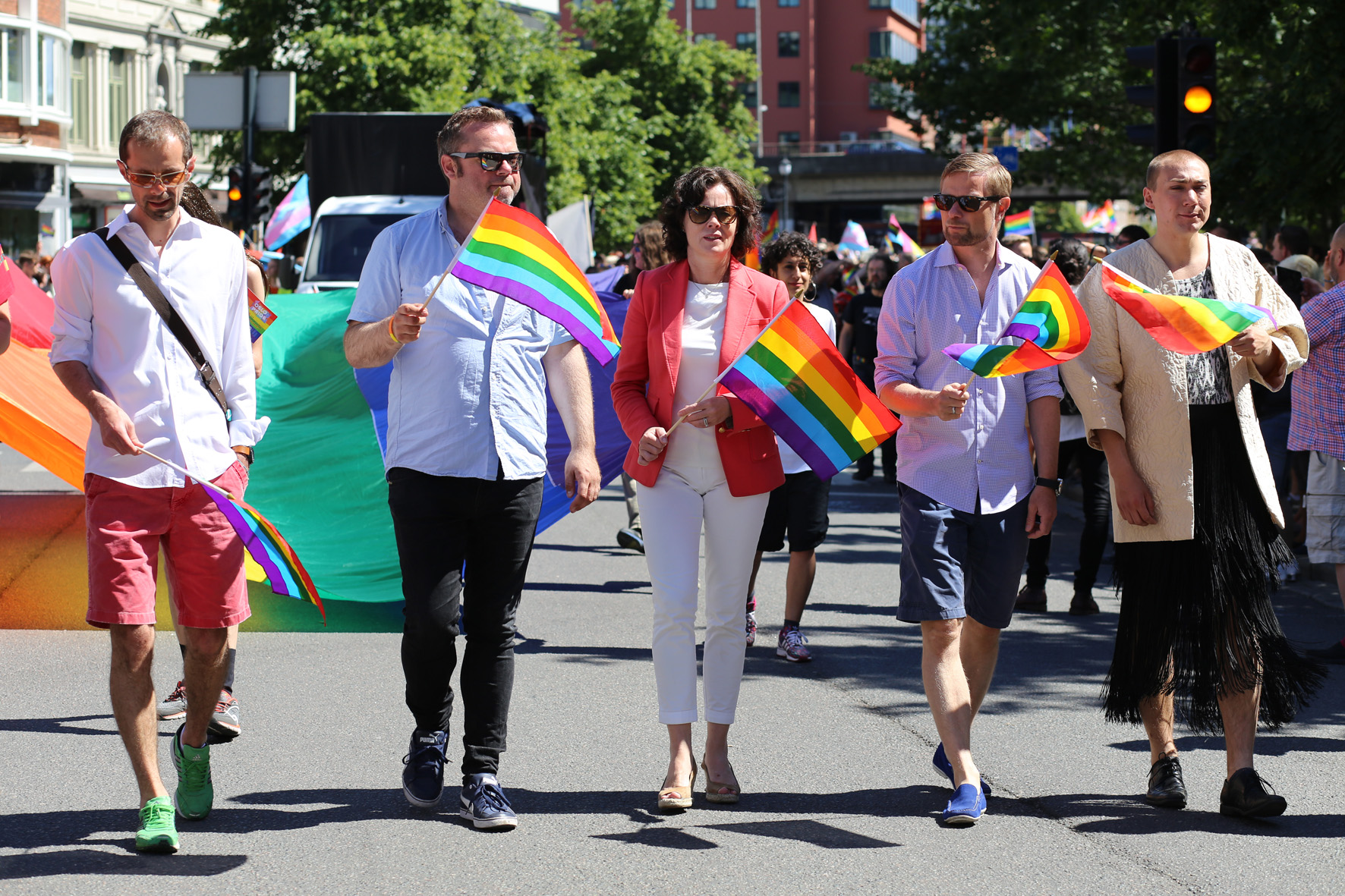
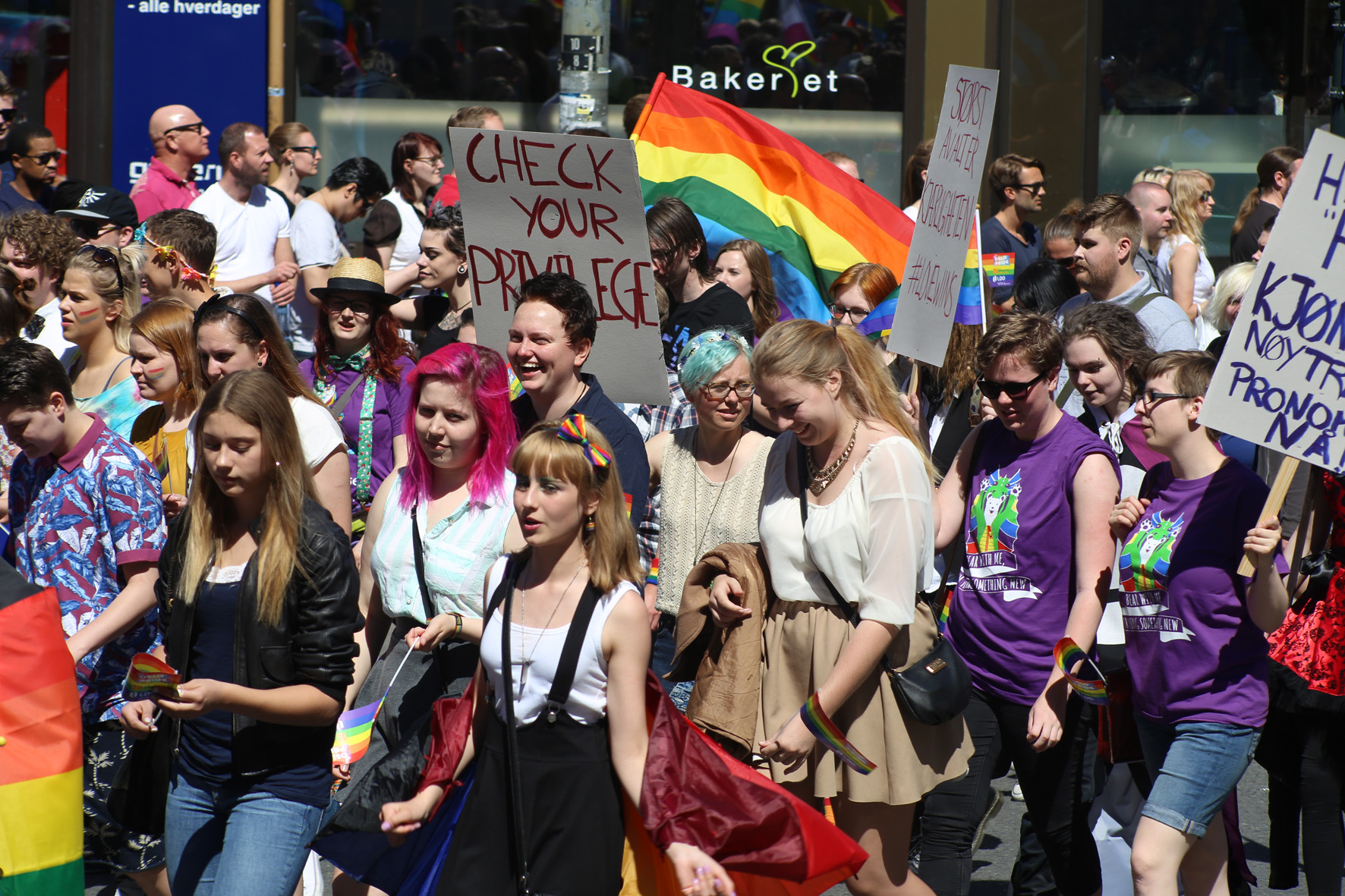
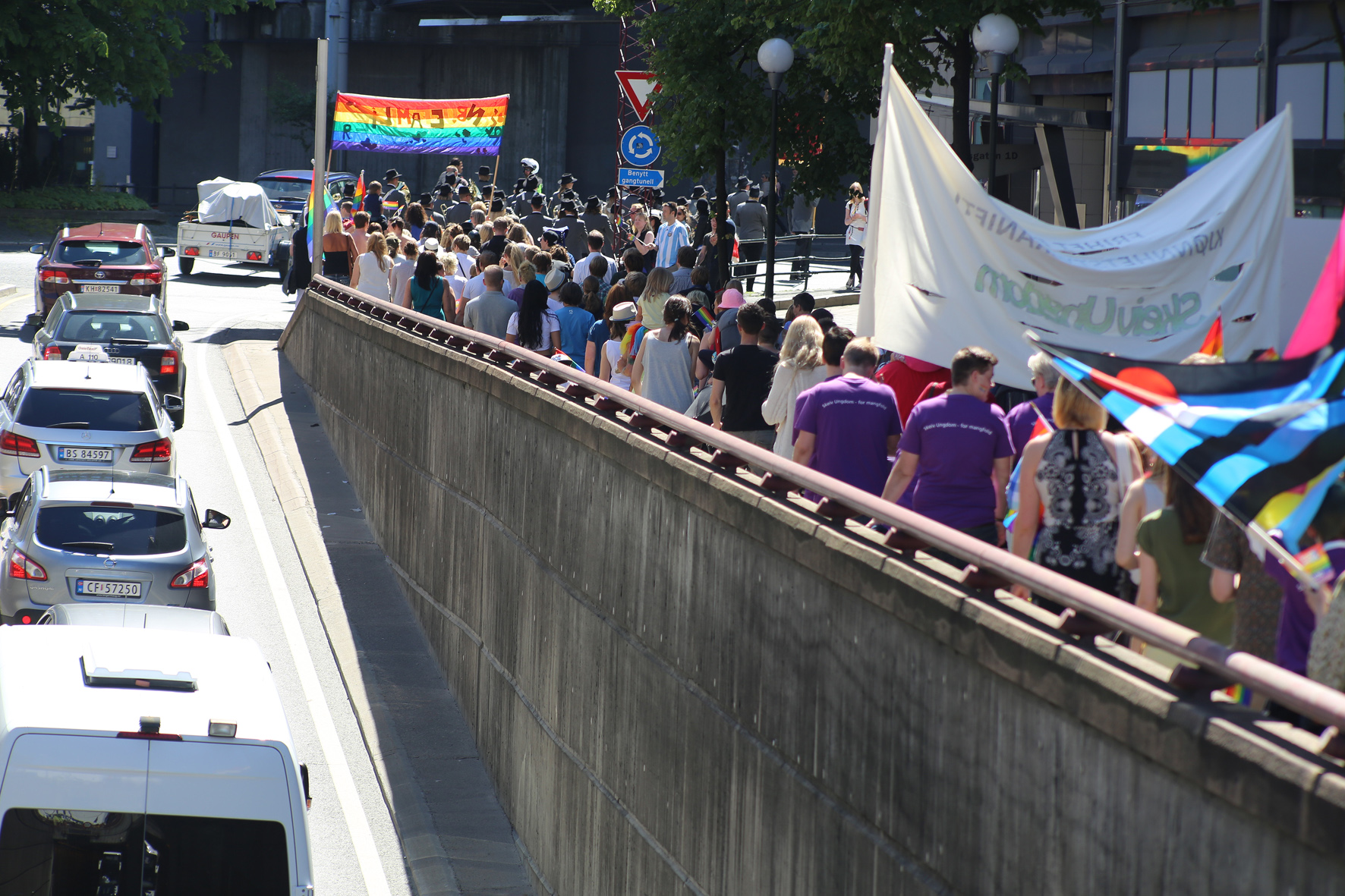
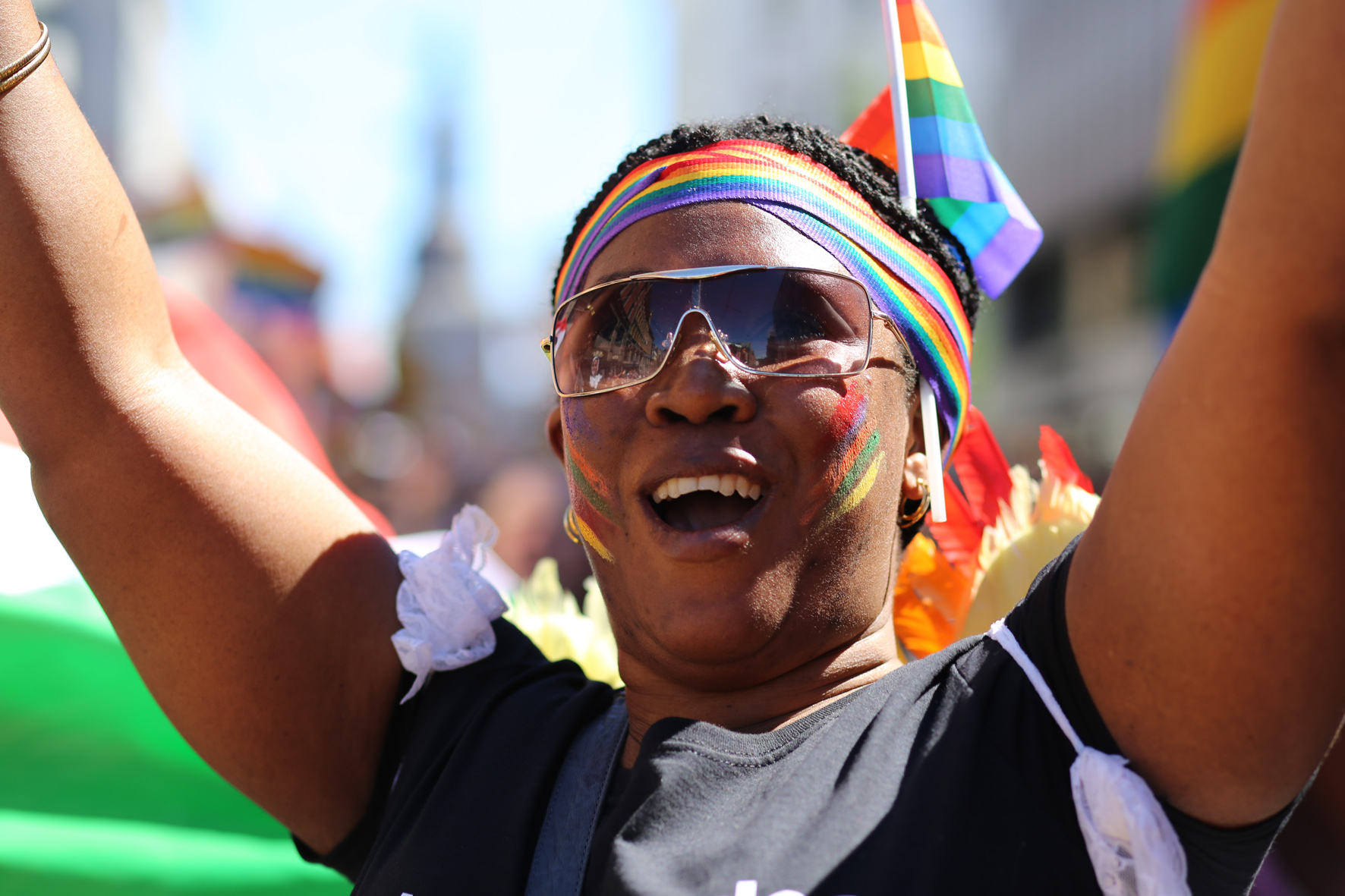
Where: Oslo, Norway
Camera used: Canon 6d with 85mm and 50mm lenses
For what: VACEP initiative








Previous links
by Zanele Muholi
Where: Oslo, Norway
Camera used: Canon 6d with 85mm and 50mm lenses
For what: VACEP initiative
Previous links
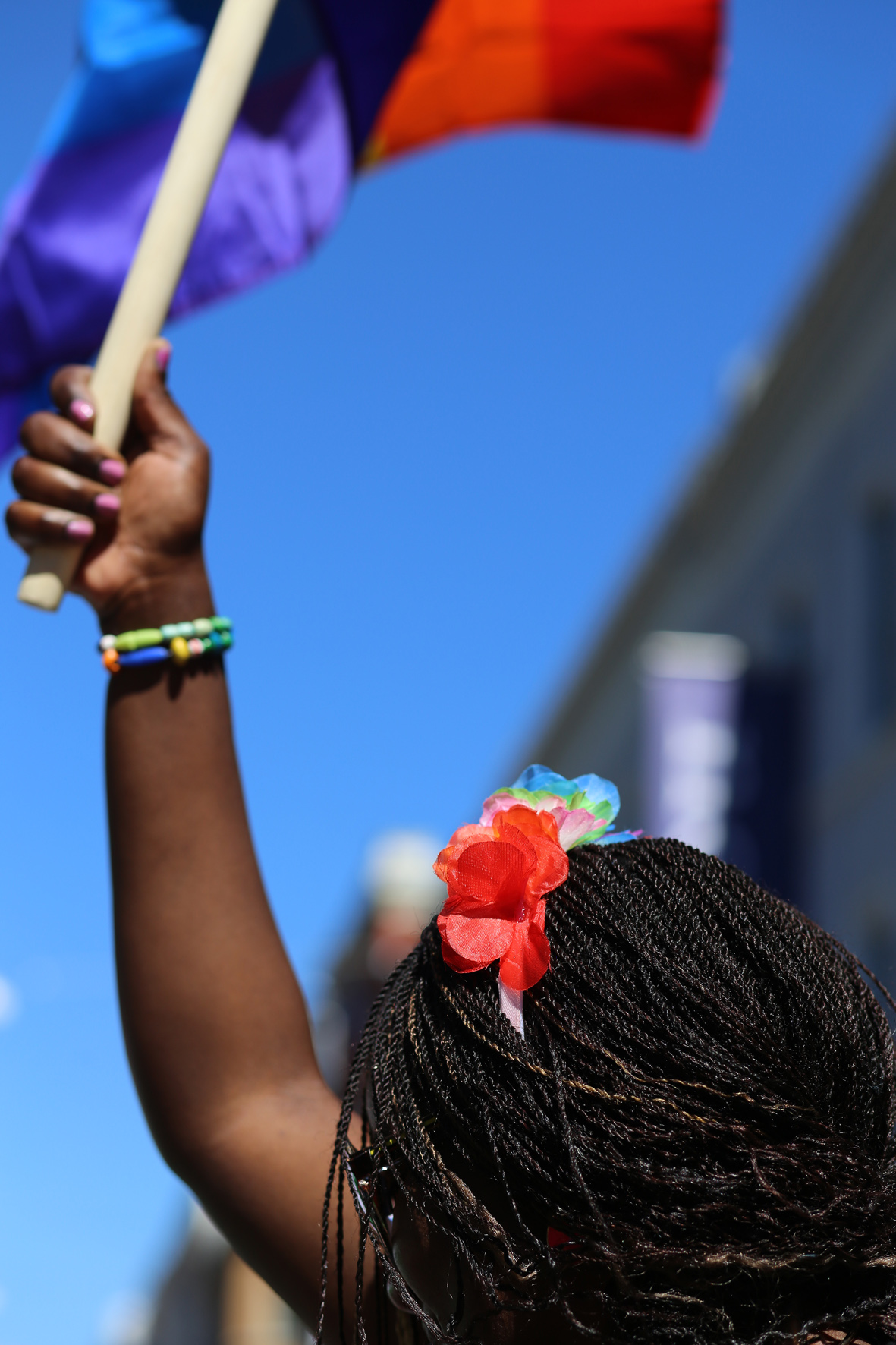
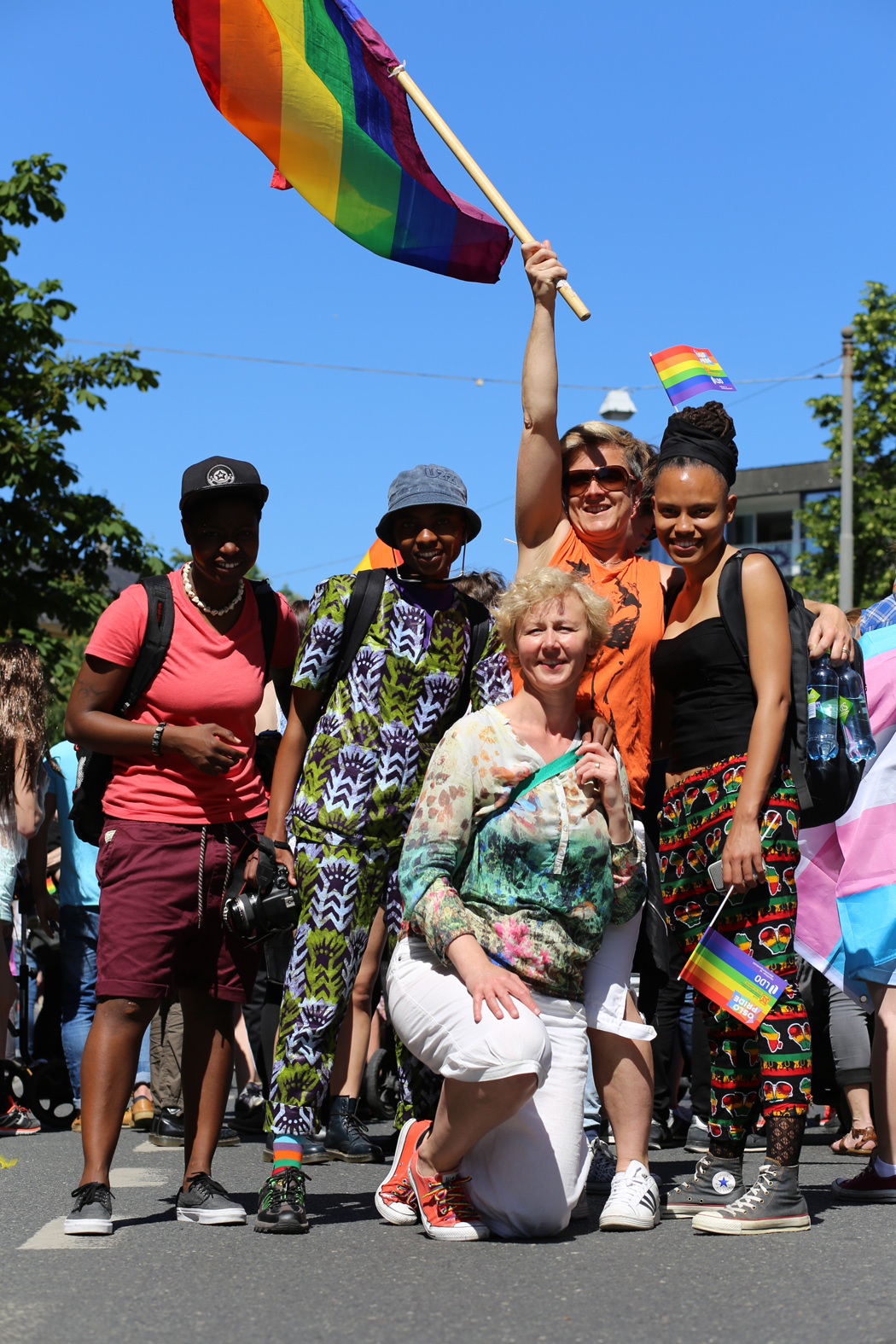
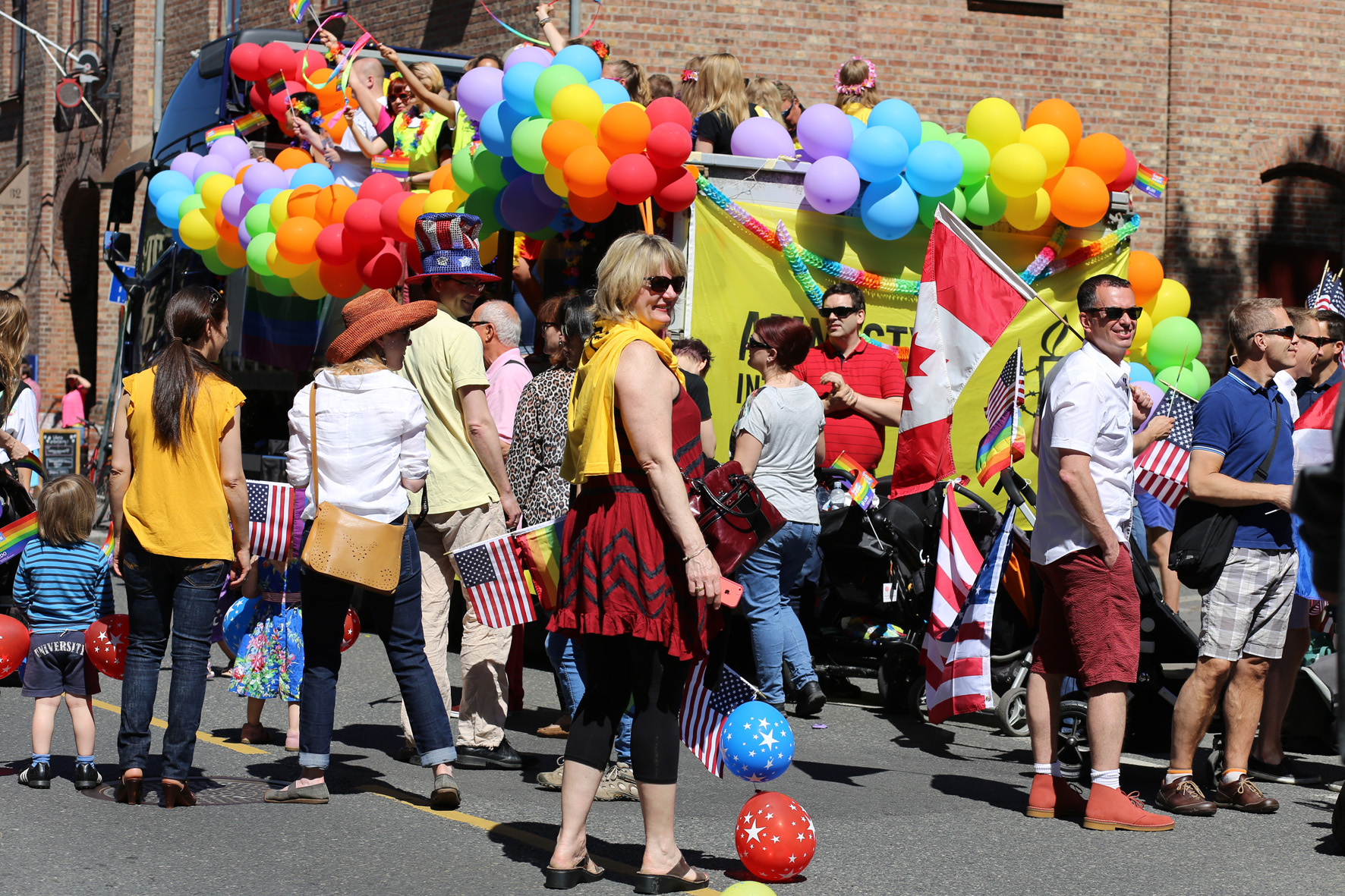
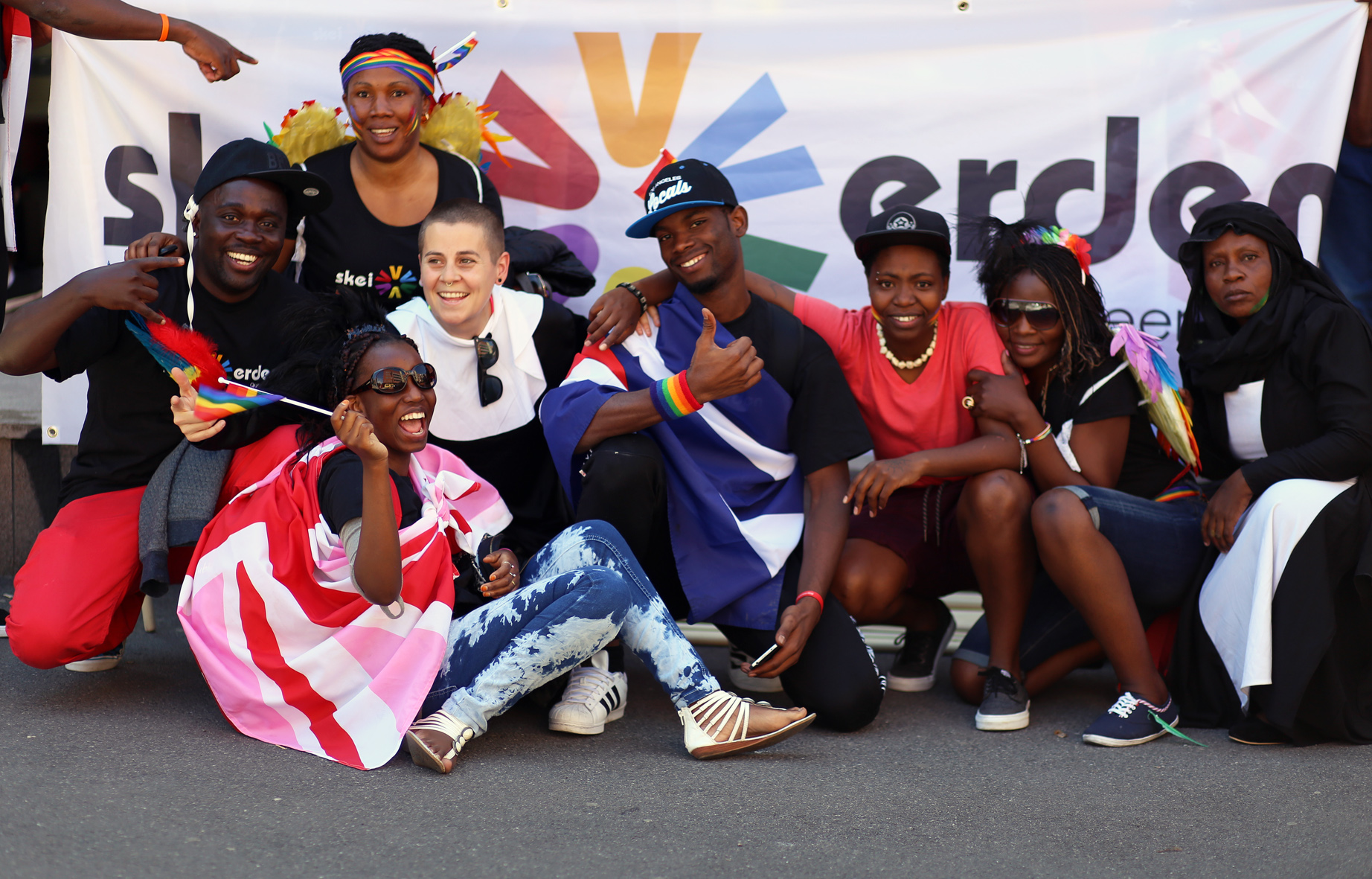
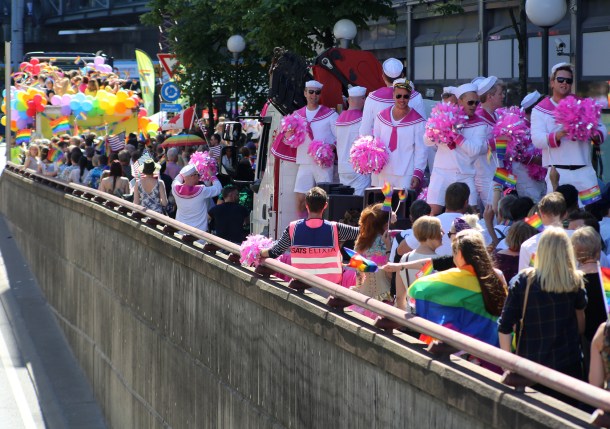
What for: Oslo Pride events
Photos by Lindeka Qampi/ Inkanyiso media
Camera used: Canon 6d with 50mm lens hand held
In Resilience
by Christie van Zyl
“Dear Young Black Lesbian
With Faces and Phases anew
Your life has officially been placed on a silver platter
Let not their misconceptions define you as pain
Let them make your fire burn brighter
For to the future generations you a torchbearer
You are a peacekeeper
You the bread to the builders who construct the bridging of gaps between us
You are a heavy-footed spirit
Because your purpose is the motif of greatness
And here in lies the existence of your life ever so blatant.”
– FossilSoul
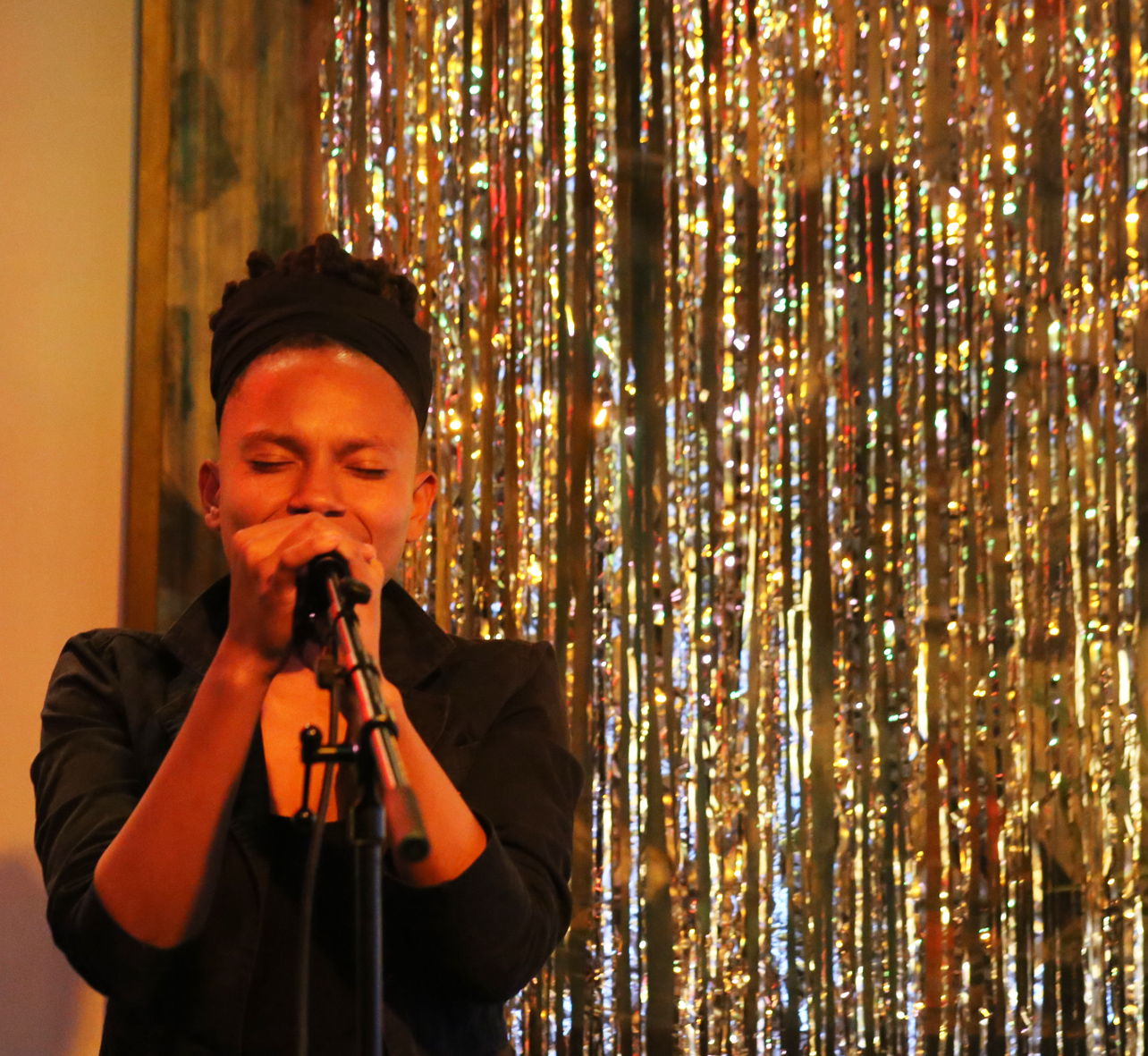
It is around 9pm in Oslo, Norway, the 25th of June 2015. Inkanyiso Media is in Oslo for a Visual Activism Cultural Exchange Project in collaboration with Kunstplass[10] – a gallery in Oslo. We all use our arts to tell the stories of the existence of our queer lives. So I – FossilSoul, take the stage at Cafe Sor in performance, as poetry is my tool of influence.
I am initially received in a warm manner as always. Performance poetry still struggles at times as we are placed in spaces that are part restaurant and part spaces of entertainment. When I first enter the stage I struggle to share my love, as the restaurant portion of the space is very noisy. I can’t even hear myself on the monitors of my stage. I step off because I do not want to disrespect myself and my art.
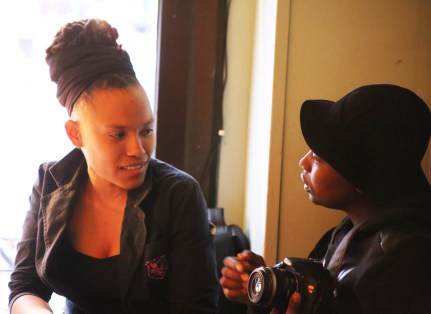
Christie exhales to Collen after coming off stage due to irritating noise that interrupted her performance…
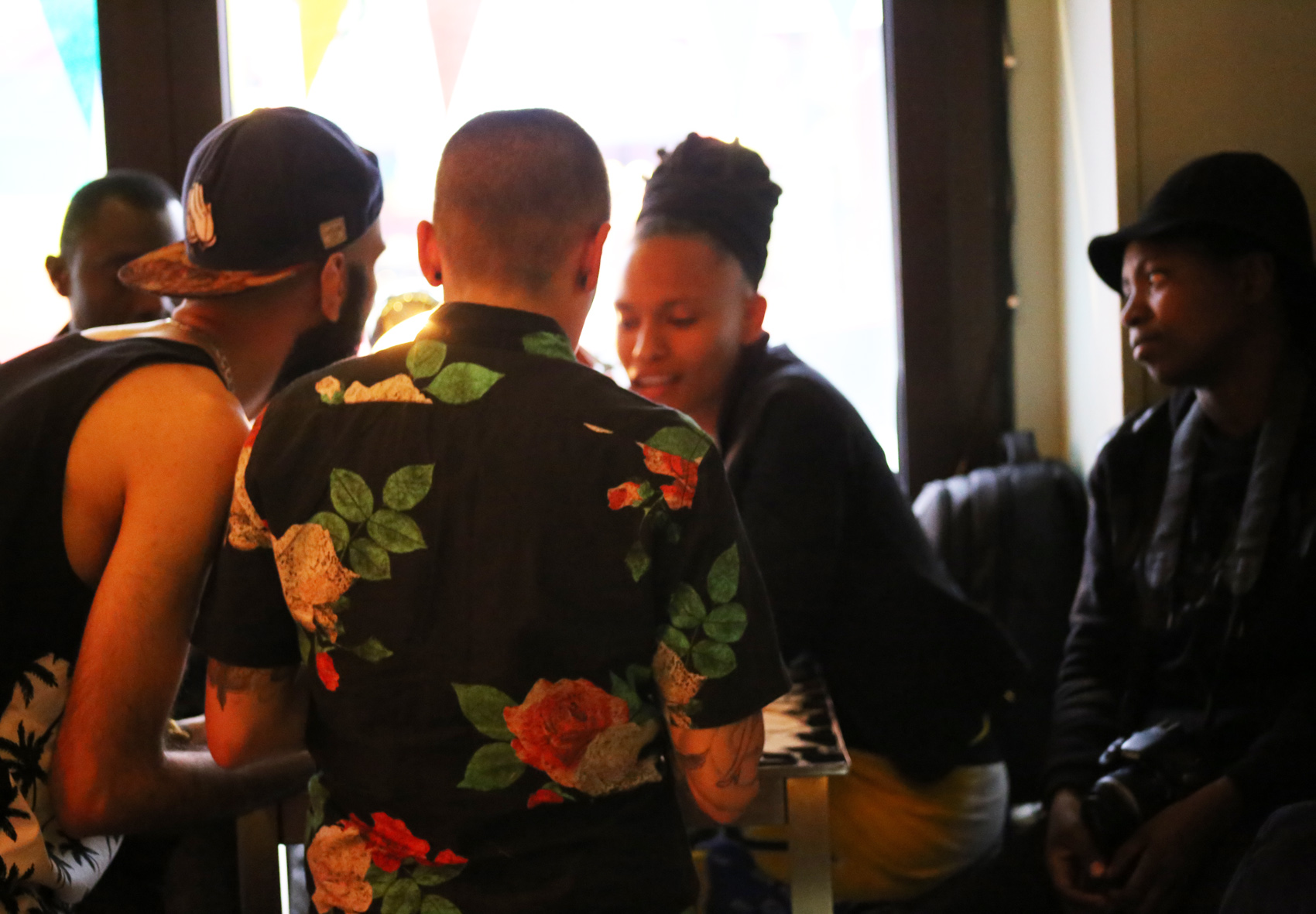
I take to the stage again and belt out a chorus of pain- ‘Liyaphela ilizwi Lethu’ – which translates to ‘our nation is perishing’. I feel that pain as I am placed in a space where I am not being listened to. This chorus is what I call ‘isikhalo’ – loosely translated as ‘a cry out’. Then and only then am I heard. It could completely dishearten me that I have to ‘cry’ to be heard; but I have to remember that we are here to spread a message of black queer visibility outside the stereotypes of perpetual victimization. And so we conquer!
I am then only able to perform the ground breaking piece ‘Ode to the Young Black Lesbian‘, intentionally titled this way as our experience of hate crimes in South Africa, has shown us that no one ever tells us that it is going to be ok. This piece speaks resilience to the young black lesbians of our community. So as we speak hope, love and resilience to our fellow black lesbians, we will continue to represent our visibility across the world no matter the odds.
#VACEP
#InkanyisoMedia
#Kunstplass10
#collaborations
#makinghistoryvisible
Previous by Christie
2015 April 13: Ode to the Young Black Lesbian
by Christie van Zyl
Faces and Phases. What should have been a follow up became a retake.
Never did I think a portrait could give me so much trouble. This afternoon Zanele Muholi asked to take a portrait shot of me for Faces and Phases, after the negatives for the first shoot we did went missing.
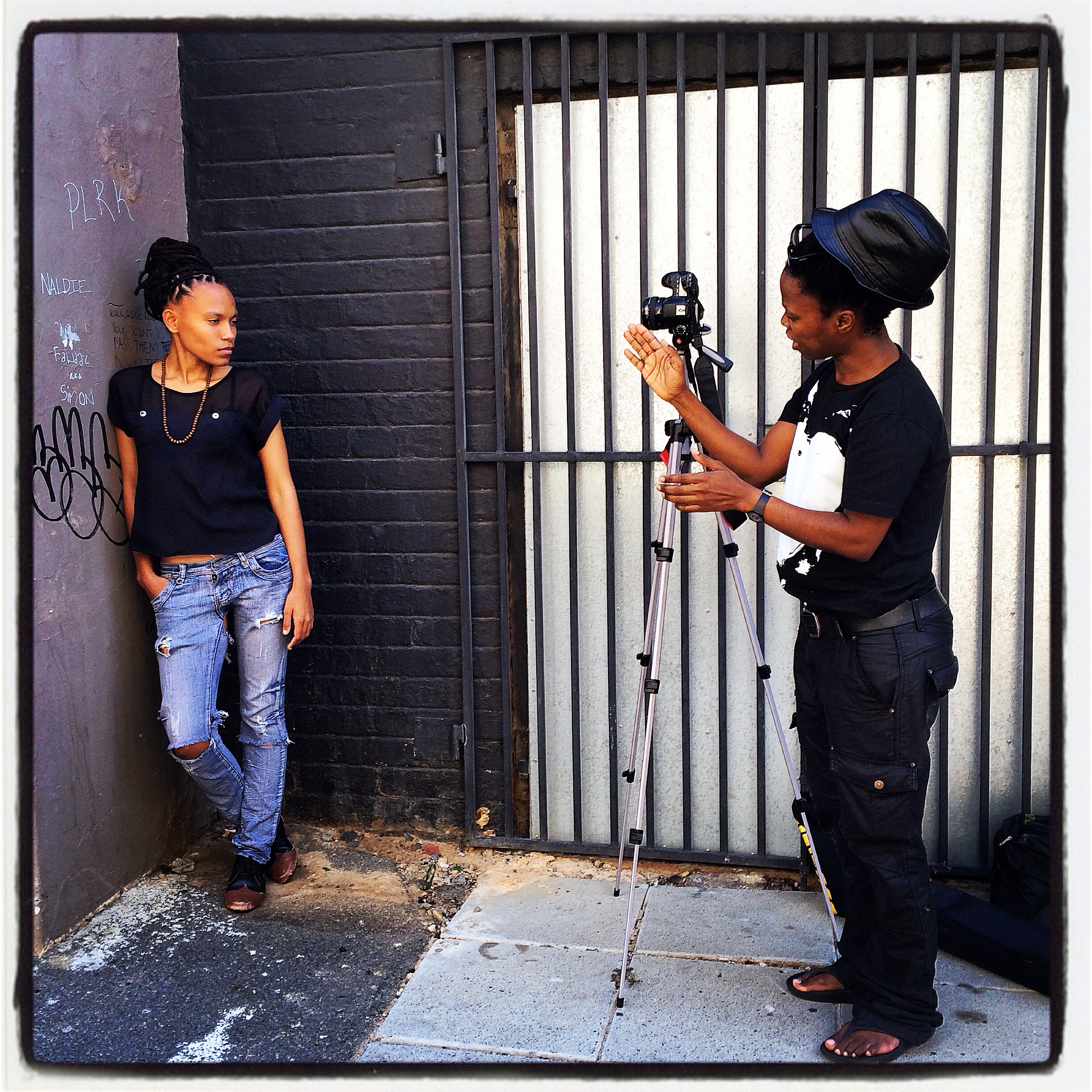
Christie van Zyl F&P retake1, Woodstock, Cape Town ( 2015/03/27) . Photos by Lerato Dumse
We had first engaged my portrait in the Khayelitsha township of Cape Town in 2012. Unfortunately between moving from Cape Town to Johannesburg the negatives of those images were misplaced. Between Muholi asking for ‘five different characters, interrogation and the space between arrogance and innocence’. I knew that Muholi was right every time she said ‘awukho egiyeni’ – Christie, you are not in your mode ‘.
Muholi came over to my apartment and pointed out the exact spot she wants to try shoot my portrait around my building, unfortunately that space required a permit. We decided to simply use the exposed walls on the side of the building where we would not have much trouble with access.
We moved along the wall of the building while I looked for the tigress in me and Muholi searched for me in my element. She kept sensing that I was not relaxed and reminded me to just breath in and out ,to stand in a relaxed pose and not be so robotic. Zanele directed my poses clearly to boast my facial features. I struggled a lot when she would throw me in the deep end and asked me for five different characters, which became confusing after she had first asked me for an interrogating look then told me that she is looking for that space between arrogance and innocence.
‘Ngifuna leyanto eshoyo nje ukuthi umuhle kodwa nawe awuzazi ukuthi uzenzeni’ yabo – Zanele Muholi
[‘I am looking for that thing that shows your beauty, that leaves even you not knowing how you achieved it, you see’] – Zanele Muholi
An agenda about beauty struck me at some point when I was no longer sure what I was communicating with my photographer, with the camera, with my friend who is looking for my personal footprint on my face.
Between shots Zanele was styling my hair ,adding and removing items from my wardrobe and making sure her bags were safe. It made me think of a time when I heard Muholi speak about the safety of actually embarking on the pursuit of these portraits.
‘Can somebody just write about the dangers of taking these photographs. The fact we have to fear for our lives while we try to archive history’ – Zanele Muholi
Lerato Dumse was standing on the side lines taking behind the scenes images of our shoot whilst uploading them on twitter to the @facesandphases account. It was a strained space with all of us being tired and drained from working back to back.

Muholi and Christie van Zyl examining photos taken for F&P retake2, Woodstock, Cape Town (2015).
We eventually concluded our shoot with wilted energy and a very clear indication that we can never find that moment from three years ago, ever again. We left that moment ekasi and I suppose the spirit of that image will live forever, commemorative in a space where Muholi has made the greatest of impacts Ekasi!!!
Related links
2015 April 13: Ode to the Young Black Lesbian
DOCUMENTATION – WORKSHOP – EXHIBITION – NETWORKING & RESEARCH – SHARING
Core group: Christie van Zyl, Lerato Dumse, Collen Mfazwe, Lindeka Qampi, Zanele Muholi, Vibeke Hermanrud, Henriette Stensdal and Isah Rakeem (Queer World)
Constantly – non-stop…J
Fri. 19 June
Friday 19th
18:30: Official Opening of Pride
20:00: Exhibition opening – “The way you look”
Pride House 20-21 June:
MANY WORKSHOPS AND EVENTS!
First: 13.00 ArtGenderArt exhibition opening and performance
http://www.oslopride.no/pridehouse/
An other highlight: 20th:
13.00: Vernisage ”Nobody Passes”
During the weekend: Artistic planning of the stay and division of tasks and roles
– Core group
Take pictures – document – write – visual activism
Sat. 20 June
Sun. 21 June
Mon. 22
Tues. 23
10-12 Queer writing session
– Linn Cecilie Ulvin (artist/author)
– Christie van Zyl and Lerato
– Isah Rakeem, Queer World
18.00- Canadian Embassy Garden Party, Slemdalsvn.43
13-16 “Kjønn” / “Gender” Art/queer/LGBTI/racism/migration context/theory/conceptual thinking/history
– Inkanyiso
– Isah Rakeem and Nina and Queer World
– Linn Cecilie Ulvin
– Bjørn Hatterud – queer/minority
Both sessions: Entire core group will contribute and participate actively – including group from Murmansk
18:00 All things queer
Queer Worlds literature group (Queer World) – Lourdes, Zanele and Zyl
https://www.facebook.com/events/851471708270799/
Venue: Kunstplass 10
Wed. 24
11.30 Lunch with Lene (Feminist Initiative – F!), Rachel (LDO –Equality and anti-discrimination-ombudet) and Sidsel activist / info women
13-15: Internal strategy exchange meeting between Queer World and InkanyisoVisit Nobel Peace Center
17.00 Pridepark – queer exhibit and concert
Self portraits taken for my grandchildren to note that I exist...
Location: 200 South Street Inn Charlottesville, Virginia, US.
During the Look3 foto festival
I took this photo in my hotel room as I wondered how to approach my conversation with CB of #Aperture at Paramount Theater.
Camera used: Canon 6D with 85mm lens
Tripod: Manfrotto H301

Related links
2015 Feb. 25: Self Portrait of the visual activist
Facebook comments and likes


I am Tshepo Seoketsi Mooketsi, a first year Communication Sciences and Anthropology student at a South African University. I am an LGBTIQ Activist and a Trans feminist who hails from Schweizer Reneke a small rural town in the North West Province of South Africa. I am a 24 year old transwoman of colour.

Seoketsi Tshepo Mooketsi portrait from her facebook page
My Body, My politics
I believe I am more than just my body. I am a human being , a living warrior who just happens to disagree with the tag society puts on my body. I believe in my bodily autonomy and i no longer live according to the societal fixed norms. I use my body to express my feelings about my own gender.
I personally feel the term ’trapped’ distorts my reality. My body is my platform where i can freely express myself. I refuse to conform to ideals which, denigrate and oppress me. I take charge of my life and my body. I wear and walk and talk in the manner i deem fit.
I am conscious about how i present my body because i want it to reflect the person i am. I adorn my body, so that it reflects my feelings about myself. This boosts my confidence as i have grown to appreciate the smallest to the largest details about it. Yes! There is no such thing, as a perfect body, but making my body feel comfortable, taking ownership and appreciating it counts.
I believe my body makes me unique and sets me apart from others,it immediately tells my story the minute I step on the streets or enter a room.
In my process of self-discovery as i began to embrace my gender identity, i experienced transphobia from the LGB to the church community. This did not break me, instead it motivated me to change these negative attitudes and speak out against violations and injustices. Now i know that loving myself and asserting my gender identity is a political statement.
Please note that this story was published in AfricTrans before.
Related links
2015 April 16: My story as a Zimbabwean Transvestite
and
2014 Aug. 30: I’m a game changer, leader and activist
and
As I write this now I’m thinking about all the good and wonderful times I had with the woman I will never forget and never see again. I’m Collen Mfazwe, a black lesbian photographer and proudly South African. This is not about me; it’s about the love that will never be replaced.
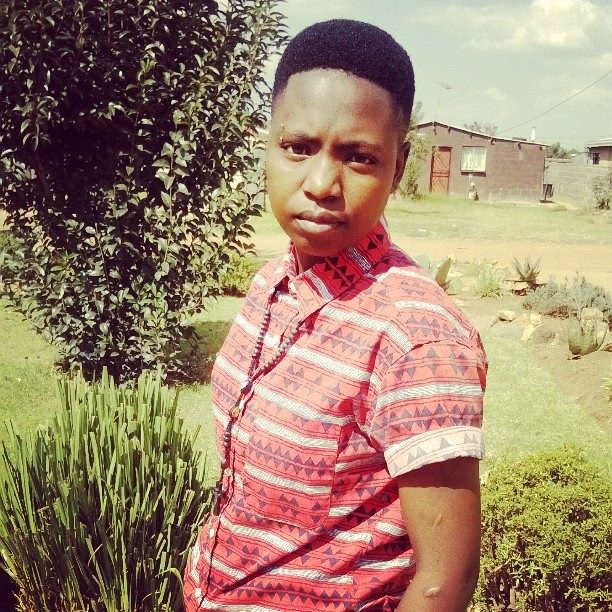
Collen Mfazwe at home. Photo included on facebook album in April 28, 2014
I want to give a little background so that you understand where I come from with this love. I was born in a family of six children, two brothers, three sisters and me. I was supposed to be the last-born but my mom decided to have twins. My older brother passed away in a car accident may his soul rest in peace. My mom was a very strong and brave woman who believed in herself and loved spending time with her children.
She also believed in God and praying for strength. We never had a father and that didn’t bother us because we didn’t see any difference, my mom played both roles in our lives. She raised six children alone, not having her own house, which was brave of her. She started working at a dry cleaner for about 3 to 4 years before I was born. Then, she worked as a domestic worker before working in schools and at the feeding scheme department.
She then got a stable job as a cashier at Pick n Pay in Boksburg and worked there for a long time. Now and then we moved from place to place because she didn’t have her own house. It was an exciting journey for me because I didn’t like staying in one place for a long time. It was only straining when I had to make new friends.
Around the years 1995 to 2000 we stayed in a place called Maphupheni in Daveyton, that’s where we settled for a long time. Life was not easy at all; we were seven people sharing one room. There was one thing that kept us growing strong and strong, that was our mother’s love.
She would go to work and come with nice stuff, the two things I will never forget is chees puffs the one that had a blue plastic with a big man wearing a cow boy hat and boots holding a sword and Danon (yoghurt) that had two sides one with nuts/muesli and the other side yoghurt. On the 25th was payday; everyone would be smiling at home. My mom used to love tea, reading novels, kip kip and Aero chocolate; give her one of the things mentioned above and she would feel better.
I was the most naughty one in the family, when mom said “come back at 6 O’clock” I would do the opposite and come after 6pm and defend my self by saying its not 6pm its after 6pm. I would come with her favourite stuff and bribe her. Keep in mind that I grew up like a boy so I would do all these things that boys do in the street, come back home with torn trousers, my bum would be exposed and would hide the trouser in a washing basket. Weekends when we do the washing they would find my torn pants, and then I’d be grounded. I would behave on the first day, then the following day I’d be back to square one.
She never had enough money for the many responsibilities she was faced with. She never failed or left us with someone else but always suffered with her children all the time. On our birthdays mom couldn’t afford to buy gifts for us. Instead she made sure she bought a cake and then wrote a long letter for you, telling you how much she loves you and how much she wishes the best for you. That to me was the most wonderful gift ever; the fact that she’s next to you, spending time with you on your birthday meant a lot me.
That is why even today I take people’s birthdays seriously. She loved doing things for herself, cleaning, washing, gardening; painting you can name them she was very domesticated.
In 2002 she bought a house, not big but comfortable in a place called Mayfield (Mina Nawe). We moved in our own home, even though we always had a home even if we were renting because a home is made out of love and dreams unlike a house made out of bricks. Mayfield is were we settled permanently. Mom always knew I was lesbian but at that time was not familiar with the word. It didn’t matter to me; I saw people like me but didn’t understand them and was always with boys playing soccer.
Mom never had a problem; instead she was worried about when I have to change in the field to wear my soccer kit. She decided to buy me boxer shorts, the shiny silky one, at that time cartoon printed bvd was the in thing. My mom started getting sick around 1999 but it was not a big deal, then she lost her job in 2001 and at that time she was taking care of us as her 6 kids and my 2 cousins, that was 8 kids alone.

We still survived, then the illness got worse and she couldn’t do anything anymore. She went in and out of hospital and we were not fit enough to take care of each other, we prayed now and then with her asking for help from God. Her mother and young sister took care of her while we were also helping. I remember one day we were all there, staring at her, she couldn’t move, speak or eat and we still had hope.
March 2005 things were hectic, on my birthday, 14 March 2005, she gave me a hug, she couldn’t buy a cake or write letters anymore, and that’s how weak she was. She told me she loved me that was the last hug and last powerful words, she said to me. I was still in school and I couldn’t cope, actually all of us battled. 29 March 2005 schools were closed, my older sister was attending matric classes and I was home with my aunt and grand mom. I went out to buy electricity for like 30 to 45 minutes when I come back my mom was gone
for good.
Things were bad. I didn’t have anything to live for because my everything was gone. Even at school I was no longer performing well. There was a time when I was staying in different places, not going to school because I had nothing to live for. The person I wanted to work for and do things for was no more. Time passed and I went back to school and had to repeat Grade 11. I passed and went to Grade 12 but didn’t do well. My focus was not school anymore but to make money so that I could help my siblings. My older sister is the best for us and is our strength. She wanted to give the twins the best education and things were hard, we didn’t do much but we did what we had to do to keep pushing.
She’s now working in retail, not earning much, but she’s pushing. I was also lucky to get a chance to study photography and I make something out of it even though it is not much but I’m still pushing. I have lots of good ideas for projects but resources are always a crisis. The twins are coming ok, one has ancestral spirits (amadlozi) and the other one has a part time job but has passion for media. Now its even worse because of me, she always says, “can you start your company so that I work for you? I think I can be your PA or make movies with you what do you think?”
We are taking care of each other just like how mom taught us.
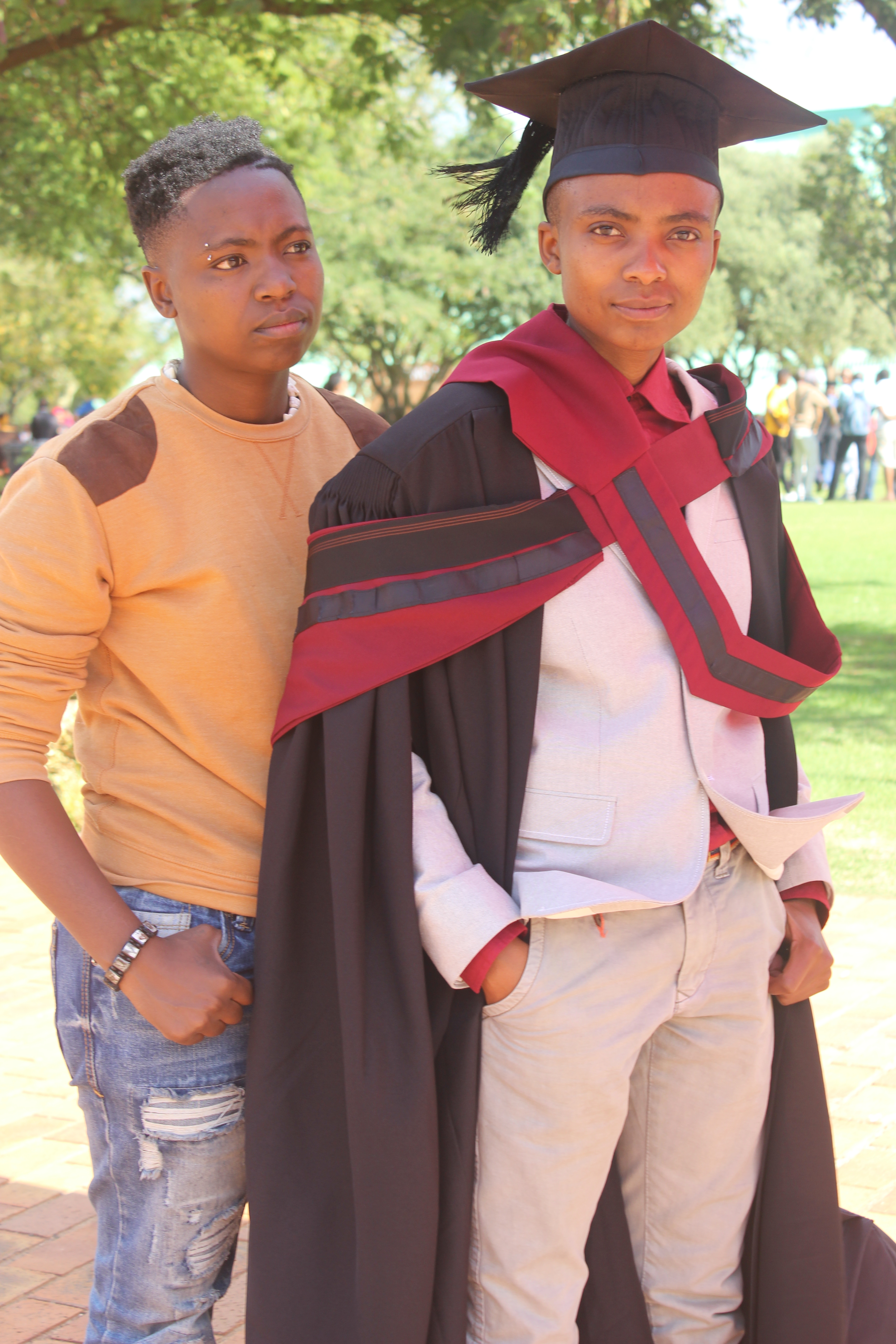
A year later, Collen documented part of Lerato Dumse’s graduation ceremony at TUT in Pretoria (20/04/2015)
Previous by Collen
2013 April 16: Not just a handsome butch lesbian
and
2013 July 9: Living in and loving the lesbian boarding house in Hillbrow
Text by Lerato Dumse
Photos by Renee Mussai
Friends, allies, LGBT community members, artists, and activists filled up the London home of Renee Mussai for a Monday (13 April) evening get together, and to inscribe lesbian hate crime related text. Despite the invites being sent out on a short notice, collaboration and efficient communication between Renee and her friend Adelaide Bannerman, yielded positive results.
When Zanele Muholi and I arrived past 7pm, we found more than 10 people spread out in Renee’s kitchen, lounge and balcony, with their various drinks in hand and flowing conversations keeping them entertained. As we walked in and started introducing ourselves, the doorbell kept on ringing, signaling the arrival of more guests. The mood was good and relaxed and filled with laughter.
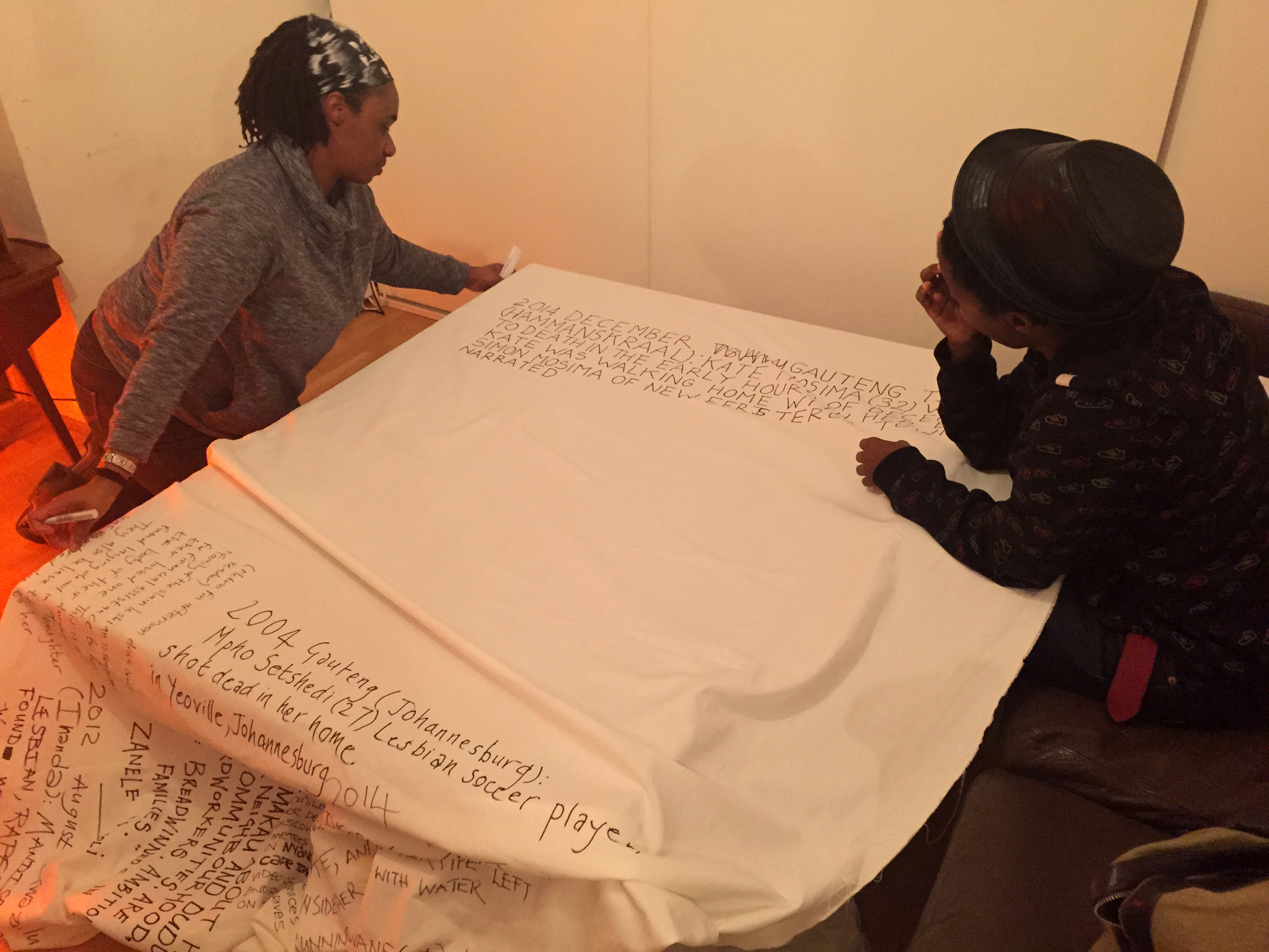
Pulling the cloth from left is Gina Nembhard who was one of the first inscribers…
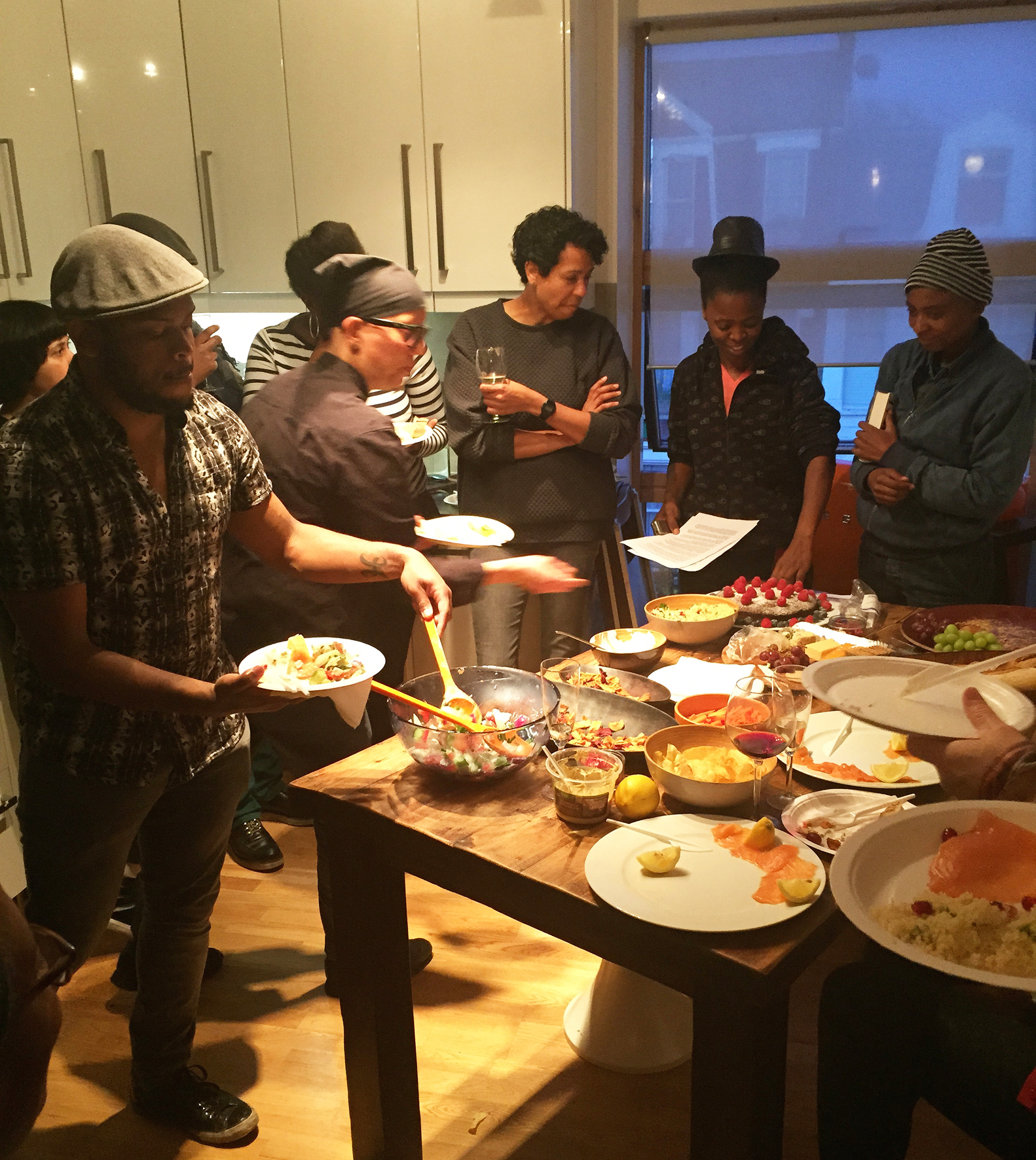
Valerie Etienne busy texting… a sign of solidarity
The cloth that brought everyone together that evening is part of Zanele Muholi’s Faces and Phases 2006-14 group exhibition at The Photographers’ Gallery, which opened to the public on April 17. The exhibition features four nominees of the 2015 Deutsche Borse Photography Prize.
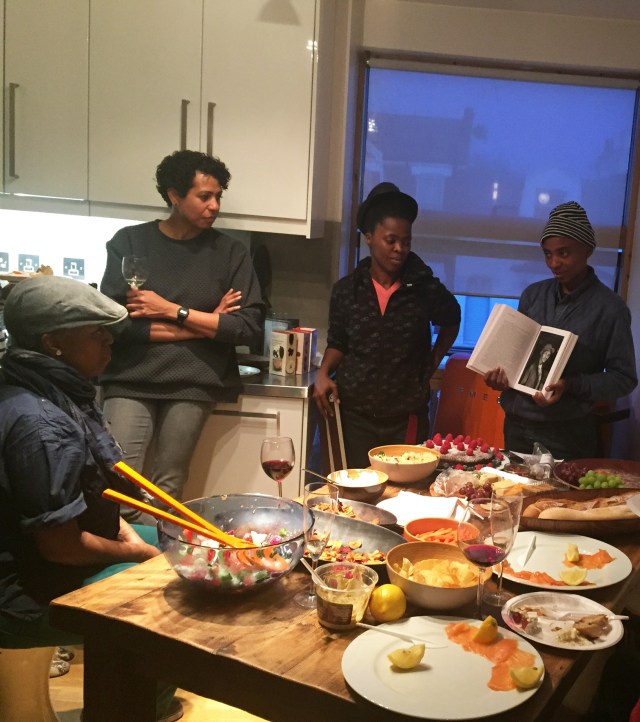
Lerato Dumse with the copy of Faces and Phases, introducing the project before inscription took place…

Love brought us together under one roof…
Renee’s kitchen table was laid out with delicious looking finger foods, and a chocolate cake baked especially for the gathering. Some of the attendees came with their children, and could not stay until late, as it was a school night.
So the cloth was laid down on the table in the lounge, everyone then moved to the kitchen for the evening’s opening remarks before text was distributed to allow for the writing process to begin.

Good friends, Renee & Robert
Muholi explained to the eager group that their participation forms part of an intervention into the issues affecting mostly black lesbians. It was also explained that the cloth would be hung next to the black and portraits of lesbians and transgender people who are participants in the lifetime Faces and Phases series. Muholi gave a special mention to the veterans in the group including photographer’s Ingrid Pollard and Robert Taylor, thanking them for their visibility and the work they have done in the years that they have worked in the art industry.
The name, surname, age, and date of the murder of black South African lesbians dating back to 2004 formed part of the text. Testimonies from relatives of those who were murdered, as well as personal accounts from survivors were also included.
The relationships between the people in the house varied from long time friends, acquaintances and complete strangers who all pulled in the same direction to create the work of art. The group were split into smaller groups of three and four people, who kneeled in front of the table to transcribe the text given to them.
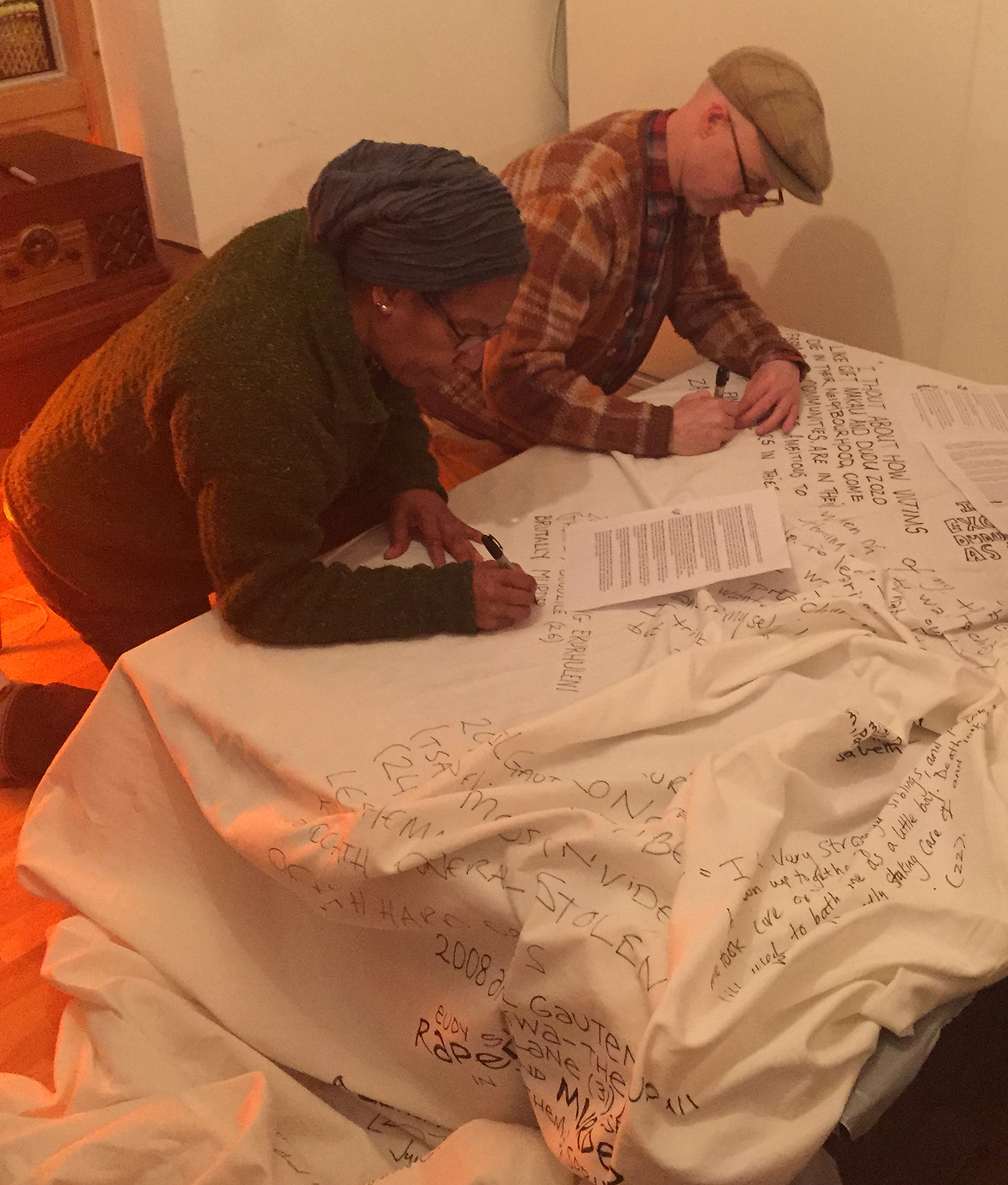
Rob Gallagher and Ingrid Pollard committed to the movement as well…
Sharing their thoughts and feelings about the process, Rob and Ingrid said inscribing the text was overwhelming and forces one to visualize the hate crime, and different from just reading about the incidents.
In her thank you note to Renee Mussai, Barby Asante wrote, “It was a really lovely evening and great to be involved in inscribing the stories for such an awesome project.”
While Gina Nembhard responded in her note by saying, “thank you for being such a welcoming and generous host!
Being able to support the work of Zanele and Lerato felt highly relevant and significant. Everybody was so warm and welcoming.”

Our friends and allies from London at Renee’s kitchen…
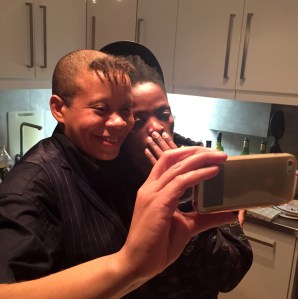
Debbie Smith taking a selfie with Muholi…
Below is the list of names of the people who participated in the inscription and we are truly grateful for all that they’ve done for us:
Ain Bailey, Adelaide Bannerman, Christa Holka, Helen Cammock, Jude Michaels, Christine Eyene, Robert Taylor, Teresa Cisneros, Barby Asante, Lasana Shabazz, Atalanta Kernick, Debbie Smith, Valerie Etienne, Rob Gallagher, Gina Nembhard, Lovinsa Kavuma, Ingrid Pollard, Cherelle Sappleton and Renée Mussai.
Related link
2015 April 15: Faces and inscriptions on show @The Photographers Gallery
by Dalisu Ngobese
So the night we came to London for had come, with hugs, smiles and kisses on both cheeks the room was filled with anticipation and nerves started to show on Zanele’s laughter. A slight uneasiness that I’ve never witnessed before was visible in her gaze as people in their own uneasiness wanted to strike a different conversation to that about the huge elephant in the room.
The obvious point that everyone kept making was why was this a competition between 4 totally different works of photography in the first place?
The answer is because there is a need to recognize the world’s most talented photographer(s) in the world. So how can you rate someone’s work as the best when they are not even in competition with anyone else and are not in the same genre or subject matter as the next photographer’s work?
Dubbed the Oscar’s of photography the Deutsch Borse Prize held at The Photographers’ Gallery London is rated amongst the most prestigious in the world of photography but with only one nominee that gets to walk away with the £30 000 prize money and that makes it even more “prestigious” I guess.

At dinner with photographers and curators at dinner
The campaign was flowing on all 3 floors the 1st was where the speeches and the announcement was going to take place, 2nd and 3rd were the nominated artist’s work all packed to the rafters. Time for the announcement and the heavy duty fell on the shoulders of 2013 winner and fellow South African Adam Bloomberg to read the winner(s) of this year’s prize. And the winner is… Mikhael Subotzky (born 1981, South Africa) and Patrick Waterhouse (born 1981, UK). The three other nominees Zanele Muholi, Viviane Sassen and Nikolai Bakharev sadly miss out on the prize and I felt the night ended without knowing how the winners were picked or what this really means for the winners besides the prize money.
I was disappointed for Zanele as much as I was disappointed for the black community in knowing that we could be fighting for recognition in spaces where what you are fighting for is not credited for what it wants to be but only for what it was. Here is a black South African in Zanele Muholi fighting to end violence and rapes against the LGBTI community and raising its status to normality by presenting positive and strong imagery of black people who happen to be lesbian or gay or bi-sexual not being recognized for her lifetime’s work and I thought to myself had her perspective been of beat up lesbians or poor gay men or homophobes her work would have been recognized tonight. In her definitive words the “world is not ready for gay content.” Certainly not in the way Muholi views it.
Related link
2015 May 28: Day Two in London
and
2015 May 27: “My excitement wouldn’t let me miss out”

Portrait of Nondi from her Facebook album
I am Nondi Nomkhita Ntombehlanga Mamntambo Vokwana born Nondi Cungwa on the 30th October 1981. I’m what they would call a bastard child, my parents Zikisa Vokwana and Xoliswa Cungwa were both in High School when they had me. My mother was in grade 11 and dad doing his Matric in different areas of the Eastern Cape, they are both Western Cape born. Naturally I grew up with my mother’s side of the family, with two cousins who were more like brothers to me Sonwabisi and Thando Cungwa. We were brought up by my grandmother’s sister who was a biological grandmother to my brothers, while my mother was still finishing school in the Eastern Cape. My biological grandmother resolved into alcohol after her divorce with my grandfather whom I have never seen and only heard of when they mentioned he was dead. I was really surprised I thought the man was dead already.
I received my first heart break in the early 90’s when my biological grandmother died. As young as I was, I knew that I have never felt such pain in my life and therefore I resented death and all that came with it.
When my brother was born on the 16 the November 1988. My parents married and we moved to my paternal grandparent’s house as tradition would have it. My mother had to go through the ‘ukuhota’ process, where you stay with the in-laws for a certain period (if memory serves me right we stayed there for a period of three years).
My parents bought their own house in 1993 which we still possess. The following year was when I can say my life actually began, I got to be introduced to this new life of being with my parents and siblings under one house hold. I must say, I really didn’t fit in with the new arrangements just like I wasn’t comfortable with the one before. I always saw myself as a Cungwa belonging to the Jola clan.
As much as they sold drugs in my previous home, we as the children felt love from everyone in my family and we were a big family held together by sisters (all my grandmother’s sisters) who kept the family strong. There was laughter and the only time of sorrow was when death creeped up and snatched a family member.
The family would sit around the fire at night and we the children would listen to our aunts and uncles tell stories of their times and about the things that happened during the wild times at home (16 Mengo Street) before any of us were born. My mother’s family dealt with drugs as a family business which then means money was not scarce. Some family members drank and some smoked weed but there were no fights, unless someone from outside touched one of them or when my uncles were involved in domestic disputes as most of them stayed with their girlfriends, then they would unleash the beast in them.
On the other hand when I got introduced to my father’s side of the family everything was completely opposite of the life I knew and loved. My father was the bread winner, he was the only one who pushed himself at school and went further through a sport scholarship as he was excellent in soccer as a goalie. The school he attended had no soccer, so he transformed to rugby for the first time in his life. He became so good they nicknamed him Pro, his coach said you play the game as if you have before, just like a Pro.
When he came back for the holidays his friends would call him ‘Ta Pro’, to this day, he is still known by that and he has been gone for 18 years. I was in Grade nine when he took his life and I can’t say I was a closet case then. Growing up in the small township like mine (Kayamandi), I never came across the word lesbian let alone meet one, honestly I never thought there was such a thing as a lesbian or knew what a lesbian is.
My father’s dad worked in white people’s gardens and my grandmother she worked in their kitchen and cleaned their house on a typical day. They struggled; but managed somehow. Together they had seven children six boys and one girl. My aunt also worked hard and she followed policing and now owns a house and a car in the same street as my father’s house.
I never knew my aunt very well since she was at the Police Academy when we stayed with my grandparents and I would see her every now and again. I mentioned that from my first family I have never encountered violence within our home, yes there would be quarrels but nothing hectic.
My uncle who is a third born from my father’s side of the family showed me a whole lot of massive violence which still haunts me to this day because at times my father would not be around and I would feel so unsafe.
The fights in my father’s family caused by my uncle would involve ou kappies, axes, machete and bricks thrown in the house through the window.
That was a norm on weekends and it was traumatic to me as I had no say as to where I wanted to be.
We then moved into our new subsidy house, my father worked for government so we were alright. My father’s family were not really fond of my mom, I guess they believed she stole him from them. But I believe they complemented each other as they were both wise financially and taking care of our home. Our lives changed, my brother and I moved from local schools to the suburb schools.
Then that was when my life became interesting, meeting people from different cultures and backgrounds. In 1995 I attended Helderkruin Primary School in Meltonrose and travelled by train.

Nondi Vokwana, NY147 Gugulethu, Cape Town, 2011
I had my first crush with a girl named Lynne and with that I started noticing plenty of pretty girls which was weird seeing that I still didn’t understand what I was feeling but it was strong for the girls. When we got to Helderkruin there were only two black pupils, it was siblings who lived in a neighbouring area Eesterrivier. I got involved in athletics and school drama. My first gig was as a translator in a musical which won in juniors where we represented the Western Cape in Pretoria, Gauteng and we won there too.
I was so proud to be part of it and made my little mark at my new school as an actor and athlete and for someone who was learning everything in English for the first time it was good.
I became popular with the girls too which was all that mattered. Yes, school work was there somewhere too, I mean I was a teenager some priorities over weighed others. I didn’t know what a lesbian is but what I was feeling was good. Flirting with the girls at my primary school became a norm with my friends, I was living a dream which always ended when our train reached our destination Du Toit which was our train station. It was more like welcome to reality. We were seven pupils coming from Kayamandi which meant we were nine in total of IsiXhosa speaking pupils at Helderkruin Primary School back in 1995.
The year 1996 I had to do Grade eight, my mother of course without my knowledge and go ahead opted to enrolled me at a school in Stellenbosch. It is a multi-racial school called Rhenish Girls’ High School. When we received a big envelop from the school stating that I was accepted at their school, I was like ‘WHAT’ welcome to have Vokwana and it sure was a school full of nothing but girls all for me to feast my eyes on, oh I couldn’t wait for that year to come.
As much as it started as though it was playing, I knew that this is reality for me, having these beautiful feelings for pretty girls. Little did I know it will soon be discouraged by someone I respected and didn’t get backup from my friends whom I trusted and felt comfortable sharing my feelings about girls with. I was scared about being known locally as I was unsure of the reactions I would get from some backward community members and most importantly my dad.
One day I walked in my friend’s house. I was standing in the kitchen and could hear her mother asking my friends about their boyfriends I was in grade 9 then and never dated anyone before. Some of my friends by then were already engaging in sexual intercourse and that was too far from my mind.
As she was asking them she said “this girl Nondi, who is her boyfriend?
I have never seen her with anyone and doesn’t she touch you girls? I don’t trust her’.
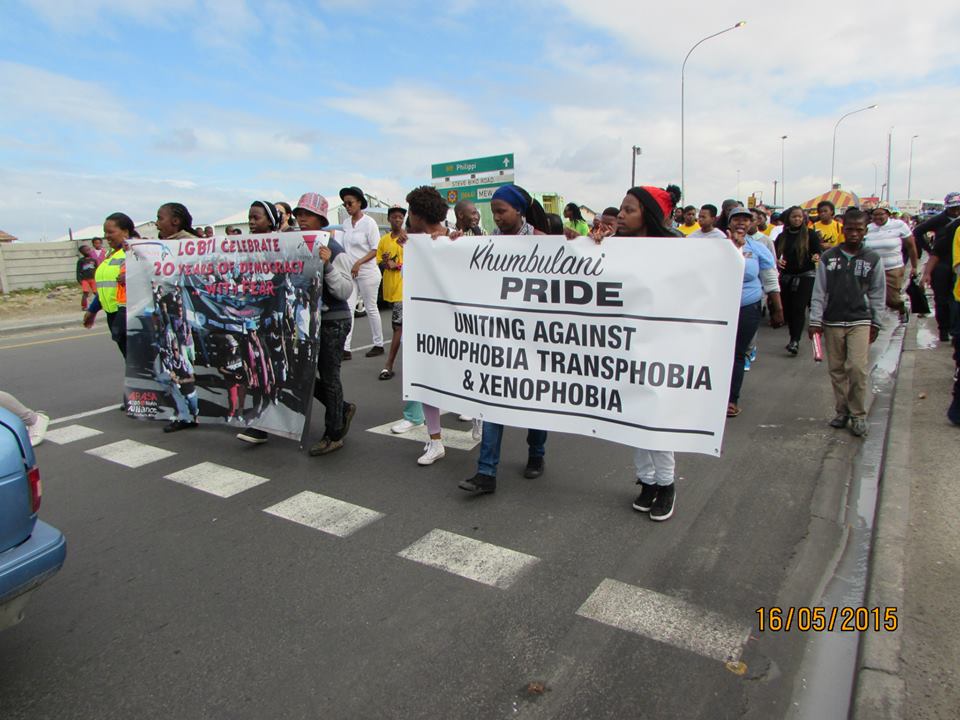
The activists at the recent Pride march in Cape Town
To be honest hearing those words and the laughter that followed cut me like a knife deep and sore. The first boy that proposed a relationship to me I said yes, I just didn’t want these rumours circulating and I was not even sure of what I was doing. In all of that I knew that I will not be engaging in sex, I was really scared of my father it was as if he will know so the thought of that restrained me from all of that. Now the funny part I had curfews on Saturday I was to be at home at 21:00 at least.
So now I was dating this boy and every second he got to be around me he would ask when are we going to have sex. This for me got to be boring because I was not going to engage in something I knew I was not ready for. At first I started telling him that he will have to wait seven years so that I can be at least 21 years of age. He became persistent so much so I told him he can have sex with other girls it is fine by me because I will not be giving in.
At some point in grade 10 I did not see the point of dating as I knew this boy/girl relationship thing was not for me, so then when I was in grade 11 in the beginning of that year I stopped dating altogether. I saw it as getting in the way of my having fun with friends because now I had to have this boy that I am not related to, to care for, hai I was not having that. Grade 11 and 12 I was single and loving it.
October of 2000 I lost my virginity after our Matric valedictory celebrations at our school’s hostel to a beautiful girl in my grade. She was experienced and a little older than me. It was my first time and we did or rather she did me three more times that night, I think I slept smiling the whole night and I played that night over and over in my head. Until I went to Port Elizabeth and had my first real relationship with a Port Elizabeth born girl and from there on there was no turning back for me. I was in heaven baby, away from home and living my life as a lesbian. All I did was to befriend gays and lesbians I had no use for heterosexuals in my personal life.
My golden life almost ended when I was attacked by a drug addict who had a psychotic attraction on me and he hated homosexuals. I say psychotic because this person wanted to take out my eyes and put them in a glass jar filled with water and he said he would stare at them all day long. One morning after coming from a club he followed me home, luckily I had people sleeping over. He went crazy, started asking about my dresses and why I don’t have a man. He sat on my chest and asked me to turn and face my left side so that he can give me the same scar on my face that will look like his. As he stabbed me, I put my hand infront of my face and he stabbed me he squeezed blood from my hand and told me to suck it and then after he sucked my blood himself. He finally left after he asked where I will be at 14:00 that Sunday afternoon so I said I will be there waiting for him anything so that he can leave my space’. My landlord moved me to another flat after we called him and my mother.
Unfortunately I had to leave College and Port Elizabeth, that month of September 2002, I came to Cape Peninsula University of Technology. In 2003 and stayed in Gugulethu during that time with my aunt. My life restarted oh yes my haven came back to me again. I dropped out in my third year of schooling got petty jobs from 2005 until in 2011 I landed a career here at Vision Afrika, I started as a facilitator at the aftercare Grade 6 and 7 after volunteering at the crèche here. Over the years and also having to work with pupils from all levels: crèche, preschool, aftercare for Grades 1 – 7 and high school program from Grade 8 – 12, that made me realise I need to go back and finish school.
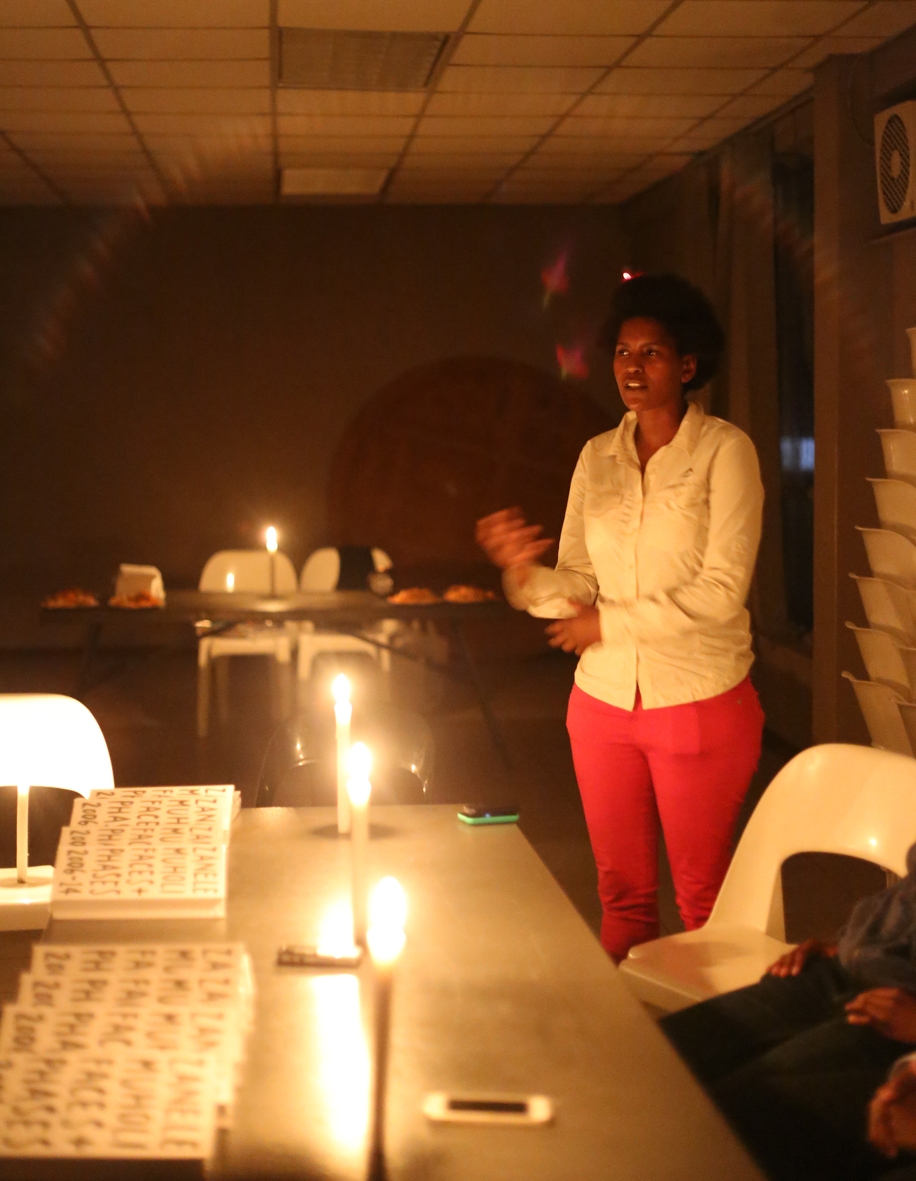
2014 Dec. 12: Nondi Vokwana at the Faces and Phases book launch. Photo by Nhlaka Muholi
I was lost for a while, after working with the Grade 11 doing community based activities, I knew that teaching is my calling and I love children. By God’s grace our branch in 2015 opened a new school called Vision Afrika Primary School. I went to Boland College and enrolled for Early Childhood Development (ECD) which I am still currently busy with the last level.
Now I am an assistant IsiXhosa teacher at our independent school for Grade 1 English medium school.
My life as we know it now.
My life as we know it now is still blessed and I still want to continue with education and activism. Aluta Continua
Related links
2015 May 5: My journey so far in life
and
2015 May 14: “I’m happy living my life the way I am
and
2015 April 16: My story as a Zimbabwean Transvestite
and
2015 Jan.3: I dropped out of the closet many times
and
 | lindiwedhlamini on Let’s go back to the drawing b… |
 | inkanyiso2009 on 6th January 2013: Victory Mini… |
 | Nondlela mjomle on 6th January 2013: Victory Mini… |
 | Elton on 2013 Aug. 27: Because I a… |
 | Nomthandazo Ngwenya on LGBTI Destiny First Gathe… |

 inkanyiso.org