Kopano Sibeko
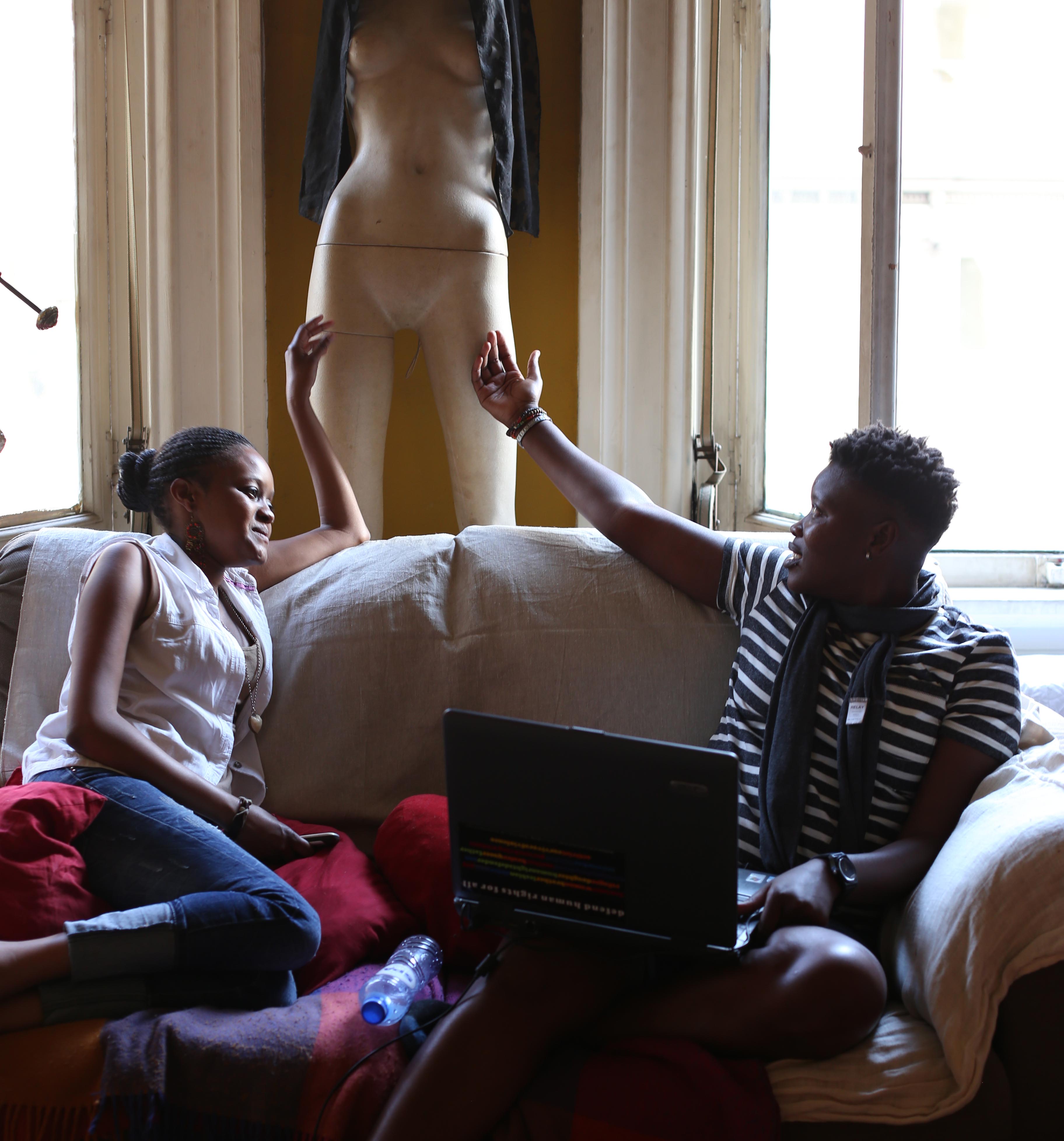
Warmly dressed in a fawn jacket that compliments his light skin tone with a beautiful red, white and black Scottish scarf. Jeremiah Sepotokele greets me with so much excitement. I quickly lit up because all that aura was channeled at my direction, with infectious immediacy the room was filled with so much flamboyance.
The ambitious 20 year old LLB student of the University of the Witswatersrand (WITS), aspires to work in transformative constitutionalism “I want to do a lot of human rights litigation and research, so that is basically my dream to work in a human rights movement” he expressed. Sepotokele attests that he wants to engage his dream more internationally, regionally and domestically “I want to have that kind of access and influence” he adds.
The self identifying queer activist says that “I would like to be a published author, one of the most celebrated social activist in this country and an academic” as he flairs his right hand in the air and uses his left one to sip on his blue mug of coffee.
His ambitious attitude draws a smile on my face while it simultaneously perplexes me, he continues to share that he sees himself taking to the Constitutional Court bench as one of the justices. “I draw a lot of inspiration from people who have carved the space for us” he admits. He further articulates that he looks up to the likes of Judge Edwin Cameroon, Zanele Muholi and Eusebius Mckaiser “they have truly asserted their own spaces and impacting the way we as queer imagine ourselves, and how the society in general continues to see us and how we are asserted in social spaces” he said.
“It’s mind blowing the work that they do, and I also see myself as having that kind of impact” he confesses. Sepokotele tells me that he particularly exudes much of his inspiration from Zanele Muholi “what I appreciate about her is the fact that when it comes to gender expression she’s totally complicit” he said. He also added that he sees a lot of himself in her because she does not enjoy heterosexual privilege. He says that Muholi empowers him and he has learnt to understand that the struggle is not about him but the queer community at large.
As I observe how he uses his hands when he speaks and the way in which he speaks so confidently, I question what drives him to be so optimistic and energetic “for me it all begins with understanding your position and the entire system of oppression“ he said. Sepotokele believes that, that is his first point of reference. Moreover he tells me that it is about comprehending your personal political space and that space is supposed to move you personally. He also says that one needs to realize that “this is personal, I am confronted with this” he points out.
The young law student voices out that when there’s anything you are confronted with in life “it’s either you choose to do something about it or you choose to ignore it or live with it and live with the consequences that come with that condition” he further adds. There are two options when you are confronted by anything it’s either you do something about it or you sit down.
“I just happen to be one person who’s, aggressive enough and my aggression is both positive and negative” he insists. He smiles with assurance and tells me that the constant struggle is to want to free oneself from certain conditions, he believes in education. I quickly pick up that he doesn’t like being caged in anyway and believes in independence.
I ask Jeremiah what influences him to have such a positive outlook on life and he smiles passionately “My greatest influence is my mother Elizabeth Sepokotele, my sister Kelebogile Sepotokele and all the women in my life, because what I’ve learnt from them is the gift of freedom” he expresses. He also shares with me that all the women in his life are single parents and what he has learnt from them is the idea of being independent.
He also explains to me that growing up he was fortunate enough to discover the importance of education as a freeing form and as a way of attaining independence, and gaining control of your own life. “So for me the enormous gift of independence, although it comes at a certain price and I appreciate that it comes at a price, but that means you got to lay the ground work” he said.
However, I’m intrigued by his attitude and I then ask again how he challenges obstacles in his life “I can tell you what, there’s one thing that I’ve learnt about facing adversity, I realized that in order to want to challenge the things that are against you, you got to love yourself that much, to want to not accept that thing that is against you” he uttered. He says that self-love makes all the difference, he states that people should love themselves enough to not allow things to work against them” for me what has been at the core of my energy is self-love” he insists.
I slowly diverted from all that positivity and I interrogated how his childhood life was and what are the challenges that he faced as a gay boy growing up. “ I think one of my challenges growing up, was growing up in a context that did not understand what it meant being different” he sighs. He tells me that what made it difficult to navigate through the space, was that the spaces did not allow for him to be different and that the consequences of that came with him not understanding who he was. The environment did not foster the chance of self-discovery, understanding oneself and building self-worth.
“So there’s a conflict between yourself and the spaces in which yourself are been brought in” he said. He shares that it was difficult, emotional and hard in every other way. “I have had my own share of bashing“ he exclaims. He explains that growing up he finally understood what being gay means, “It has parts of expression, it encompasses some gender expression but it is not what makes you gay. It is something that is complex and as complex as it is it has little to do with wanting to be a female”, he added. Sepotokele says he’s truly grateful to have met people that made him comprehend the true sense of self in him in this difficult time in his life as he was developing as a flamboyant boy.
Sepotokele explains to me that he is openly gay and his family has accepted him and loves him as he is. However he tells me that when his mother found out that he’s gay she was not surprised “my mother was not surprised; but what really took her apart was that I confirmed her suspicions, because she always suspected that I was gay” he laughs, “when I confirmed it; it was a different reality” he added with more laughter.
“What I learnt about her acceptance, is the power of love, and that it transcends prejudice and pre-conceived notions of what being gay is, ” he admits. He further explains that love transcended and love prevailed; he says his mother sees him as her son before she sees a gay man.
As I observe how his face lights up when he talks about his mother, it slowly turns red and his facial expression suggest that she means the world to him. I couldn’t help but wonder where his father is, and he said “my dad was an absent father”. I also mention that you find that other people especially men find it hard to be productive without a father figure and they blame their failures on that he’s response was “presence is not sufficient”. He uttered that he actually has a problem with that because it insists on heteronormative institution as a way of stabilizing our society because that automatically disqualifies queer parents to raise their children because it will be deemed as ‘abnormal’. He also voices out that “ yes it’s sad to grow up without a father, a mother or any form of support but I have a particular problem on relying on that, to say that I can’t do ABC because I don’t have parents” he expressed. He says there are people who are brought up by both parents and they are messed up, “who do we blame then?” he asked.
Sepotokele reaffirms that what drives him, is the fact that he holds a particular vision, and that vision is the center of his life and he will not rest until he lives that vision, he said “I live like a normal 20 year old gay guy, I party, I have fun, but I always go back to my vision” he smiled.
In my thoughts as I walked away from this great sitting I realized that I left that space as inspired as one should be daily, but the greatest thing I’ve learnt is that self-love comes from understanding oneself and that love transcends all.
Previous by Kopano
2013 Aug. 7: Reality Check from the 2013 World Outgames
and
2013 July 31: Almost all about my first time abroad
and
2013 July 15: The virus has become a silent relative
and
2013 July 10: Chaotic memorial service for Duduzile
and
2013 May 11: Actually, absolutely, definitely NO!
and
2013 April 21: Living a legacy is always better than leaving a legacy
and
2013 April 23: Intraview II
and
2013 April 16: Not just a handsome butch lesbian
and
2013 April 9: I refuse to be abused

















 inkanyiso.org


2013 Aug. 15: The documentation of black LGBTI in South Africa
Uncomfortable political representations and the public imagination
by Jeremiah Sepotokele.
The documentation of lives of the black Lesbian Gay Bisexual Transgender Intersex (LGBTI) community remains one of the most socially and politically contested space in South Africa.
Jeremiah, speaking at the Gay and Lesbian Memory In Action (GALA) website launch called Hear Us Out held on the 17th May 2013 in Braamfontein. Johannesburg.
Documentation is a powerful instrument which has significant political meaning because of its preservative strength and generally can be used as an important point of reference in asserting queer existence. I would be narrowing my focus specifically to “black” queer documentation as I believe that is where the inadequacies particularly lie. Although there have been literary and academic projects that have performed the function of documenting black queer identities in South Africa, I would like to consider the problematic representations made where these projects are mostly directed by white professionals.
Moreover it is also the dominance of white queer narratives which are problematic as they consistently make it impossible to conceive black queer existence.
Some SA books with LGBTI content
There is a significant shortage in a number of black writers, artists, academics, etc. producing work in queer identity and culture that thoroughly reflects the black condition in this country. Zanele Muholi is one of the very few professionals that have responded to these frustrating inadequacies in queer representation. Muholi’s documentation of black lesbian, gay and transgender community in townships and beyond speaks to lack of representation and it is in this lack that our stories are susceptible to further misrepresentations. So claiming these spaces means that we insist in the mainstreaming of our lives.
Furthermore it is also essential to recognize that this dynamic raises the inequality which exists even in the LGBTI community; white privilege against black hard-up reality. I would like to believe that there are many black queer South Africans who are excellent story-tellers and artists; however there are limited outlets which are available. It cannot be ignored that this screams volumes in what remains the priority in the general documentation of queer identity and I cannot help it but grasp it as something that is of racial-political significance. Maybe one might assume that I am over-playing the race card here, but it is a fact that the majority of the queer literature (scholarly, artistic, literary works) is been produced by white professionals.
This is often taken for granted because there are assumptions that the realities of members of the LGBTI community are purely similar and that seems to condense our individual struggles into a single tin. This is a very dangerous assumption to make because we are first and foremost “raced” and with that follows our individual economic and cultural background which is undisputedly significant. Considering our cultural contexts comes in the light of the debates made around how un-African homosexuality is, and it is the lack of black LGBTI documentation that potentially and materially harms the advancement of black-queer identity in dominant Africanised institutions. So then this goes to perpetuating that homosexuality is un-African if we are going to always question the accessibility of forums that allow for the ownership of black-queer representation.
Balancing Act (2005) cover photo by Zanele Muholi.
Edited by Joanne Bloch and Karen Martin.
Book title named by Donna Smith & Zanele Muholi
Finally I do concede to the fact that it is a difficult one but it is important that we interrogate who really documents “black” LGBTI lives in South Africa. Furthermore, who is responsible for the lack thereof. The question of accessibility of alternative forums is a sticky one as it intricately linked with socio-economic politics of this country and therefore how does one suggest navigation from this thorny reality if one can’t even afford to access alternative platforms.
About the author
*Jeremiah Sepotokele is a 3rd year LLB student at the School of Law, Wits University.
He is an Editorial Associate at the Wits Student Law Journal for Southern Africa and a Teaching Fellow at the South African Constitutional Literacy and Service Initiative.
Previous on/ by Jeremiah
2013 July 29: Education, Queer Youth, Hate Crimes: So where to from here?
and
2013 Aug. 13: Love Transcends and Love Prevails
and
2013 May 18: After Mask … Hear Us Out
(Un)related link
http://mg.co.za/article/2013-08-11-andile-mngxitama-decolonising-the-african-queer-movement