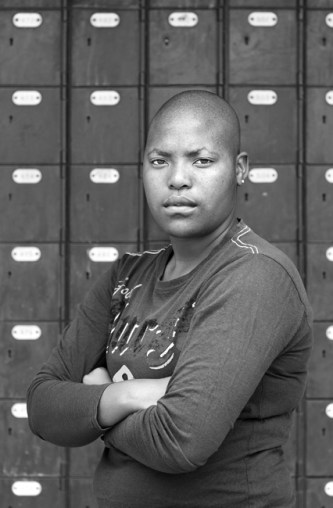
2013 Oct. 18: Transition is in your hands

by Sbu Kheswa

This piece is inspired by Njabulo Masuku’s article: Frustrations of a transgender man.
Boy, I can really feel your frustration.

The challenge is that there are many other transgender people in Njabulo’s shoes.
In fact, the wide gap between the promises of our Constitution and the reality is the daily experience of many South Africans. Think of the high unemployment, the service delivery protests, people living in shacks during the rainy seasons etc.
I agree this is unacceptable.

As a transsexual man, who works for a transgender organisation, Gender DynamiX, I feel like sharing a bit of my personal story when it comes to the challenges of choice to transition.
Sure – I believe I was born transsexual but I had to make a choice to transition or not.  That required a lot of research, considerations and calculations.
Sadly, the general experience of many people who chose to transition is that of loss.
Family members, friends, comrades can divorce you and even worse, employers can make your life very hard.
On top of it all to transition can be extremely expensive.
The services are not yet readily available and that means only people who have the means for cash can do this with less pain.

As I had a job when I chose to transition I could afford a private psychologist.
Thank God for the Standard of Care as those sessions with a psychologist are no longer a requirement.  I would still recommend that people have someone they can talk to about the decision to transition as there is a lot to consider. So the visit with your psychologist or social worker or your prophet or sangoma or whoever you chose might be very beneficial.  Later on I could afford hormonal therapy through private doctors.

Getting employment with Gender DynamiX really opened my eyes. I got better understanding of the work of the transgender organisations here in South Africa. These organisations are there to advocate for the human rights of transgender people. Given the available resources it is highly impossible to serve individual needs of transgender people.  These organisations do their best to direct people to available services and to provide people and service providers with information.

Like everyone I had heard that Cape Town is the best for transgender health services. So I was so happy when I got the job with Gender DynamiX and moved to Cape Town. Shortly after that I made my first appointment with the transgender clinic in Groote Schuur Hospital.  I made sure the surgeon knows that I work for Gender DynamiX and he even sent his greetings too some of my colleagues.
He patiently explained to me how the system works and he was willing to put my name on the list.
Before I could even leave the building I had already made my decision to approach the bank for a loan as waiting for 25 years before my first op was going to be impossible.  My colleague tells she has been on that list for full 12 years.

I wish people could know that there is no special funding that is reserved for individuals’ hormonal therapy or for surgeries.
Donors give organisations money to change systems for the benefit of all.
As an activist who is directly involved in fighting systems I’ve also had to realise that things are not going to change at my pace.  There are meetings and meetings and processes and processes that are involved. The only thing I can do is to keep keeping on.

Maybe this piece will not give you much hope but I really hope it makes you realise that your transition is in your own hands.


About the author

Mr S. Kheswa has been working in the South African LGBTI sector since 2002, where he has held positions at Gay and Lesbian Memory in Action (GALA), Forum for the Empowerment of Women (FEW), and the Lesbian and Gay Equality Project.

He is a passionate advocator for the most marginalised in society with a strong history in advocacy in a number of human rights based organisations.
He has keen experience in an array of gender based work within South Africa and more widely.
He has worked on various research projects, public education and oral history projects.
He is also a skilled audio-visual historian.
He has presented on different local and international platforms.
His works includes co-writing a chapter in a book: Tommy Boys Lesbian Men and Ancestral Wives: Female Same-Sex Practices in Africa.
He also co-directed Breaking out of the box, a documentary film on black lesbian lives.

Related articles and videos


2013 Aug. 9: Transgender youth suicide in Johannesburg

and

2013 Oct. 4: I sensed something was wrong
and
2013 March 12: Trans(parent) interview
and

2011 May – GDX – SIPD Exchange Programme

Posted in Evidence, Experience, Exposure, Expression, Family, Finances, Friendships, Gender naming, Human rights, Interpretation, Invisibility, Know Your SA Queer History, Knowledge, Lack of Resources, Lessons learnt, Life, Love | Tagged | 4 Comments

2013 Oct. 18: Collaborations are essential


by Lerato Dumse

Four days after the opening of the 2013 Carnegie International. An exhibition at the Carnegie Museum of Art in Pittsburgh, Pennsylvania (USA), which features 35 artists from around the world.

Zanele Muholi’s work is part of the exhibition and is also a recipient of the Fine Prize.
An award created in 2008, to honor emerging artists who are part of the international. The prize comes with $10 000 from a 5million gift, made by the fine foundation in support of the international.

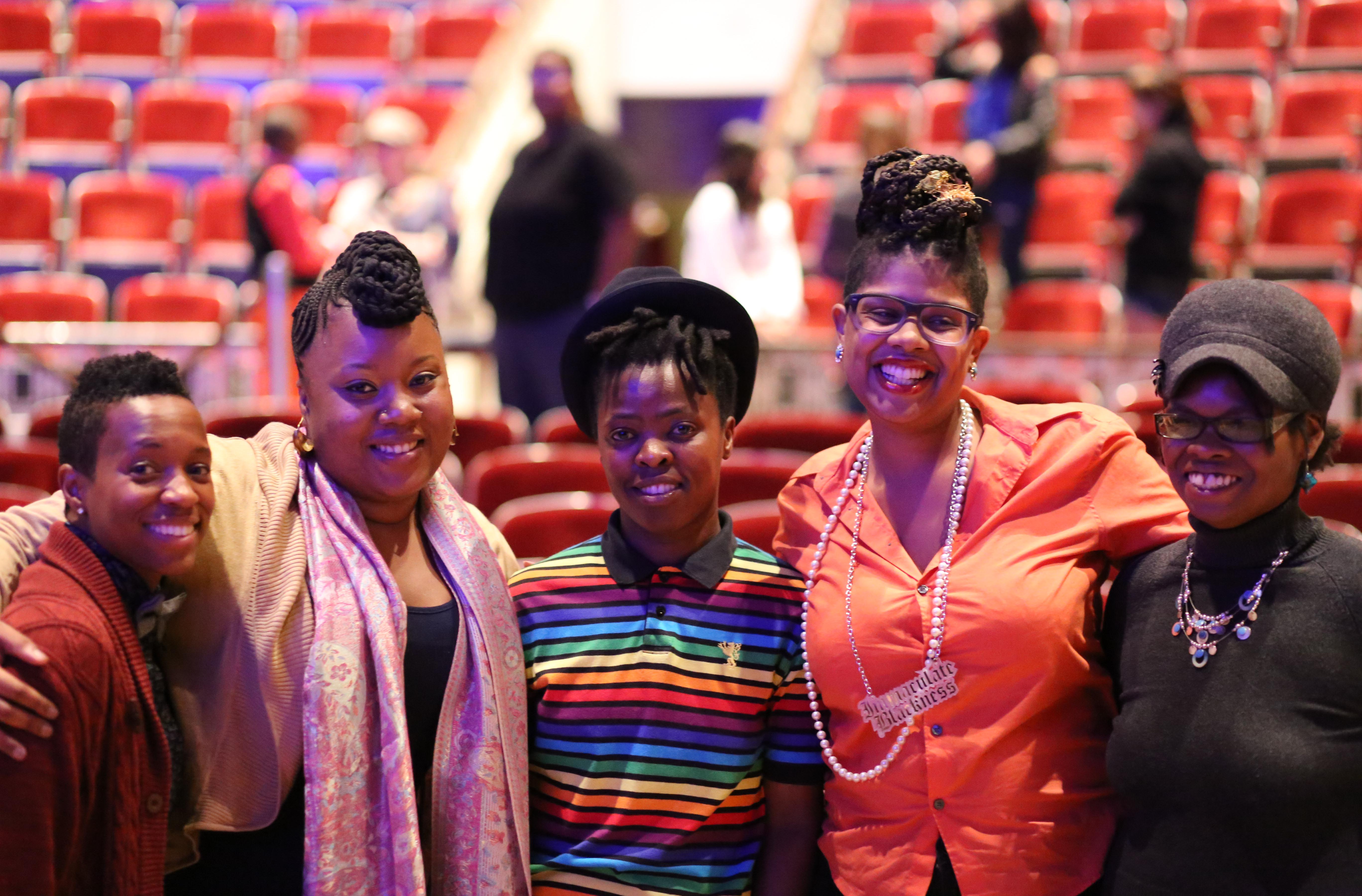
ayanah bekezela muholi joy & friend_8238

Photo by Raquel Rodriguez of Queer and Brown initiative

Muholi gave a talk on the evening of 8 October 2013, attended by more than 100, mostly local residents who came to hear what the renowned artist had to say. The audience consisted of both young and old, queer and straight. Most encouraging for Muholi was the mixture of different races, a real novelty.

However, it was not by chance or a miracle, it was because of collaborations made with Bekezela Mguni and LA’Tasha Mayes from the organization New voices of Pittsburgh, women of colour for reproductive justice. Together with Human Equity and Art (Heart).

Ayanah Moor, an artist and associate professor at the school of art at Carnegie Mellon University, introduced Muholi and also facilitated the Q&A process.

She said Muholi’s work, “makes visible, the lives of black lesbians and trans man with a dignity and pride that can’t be denied.”

Faces and Phases is the black and white series of black & white portraits featuring black lesbians and some transmen, was also described by Prof. Moor as, “disrupting the violence that aims to silence and control the black queer community. It records and immortalises just as it takes a defiant public stance, including work done by inkanyiso media.”

When she got on the podium Muholi explained the film work is an artistic response against homophobia and ‘curative rapes’ that are ongoing in South Africa.
Including the short documentary film titled: Isililo (Outcry from the nation).
It was produced on the 16th of July 2013, three days after the funeral of Duduzile Zozo, who was brutally murdered in June 2013 in Thokoza township, Ekurhuleni (Johannesburg).

Before it was screened, Muholi gave background into the making of the film and said she was thinking of all the mothers mourning, after losing their homosexual children to hate crimes.

The artivist also spoke about a wish for a space where everyone will join forces and fight hate crimes, even those that are not lesbian, gay, bisexual, transgender and intersex (lgbti). “We are all connected to an lgbti person. Whether through a service one provides, school, work, church” and informed educators that It’s okay to have a queer student.

Then a longer documentary was screened, although it also tackles serious issues, it has a much lighter tone and approach.

It shows Muholi as a hairstylist.

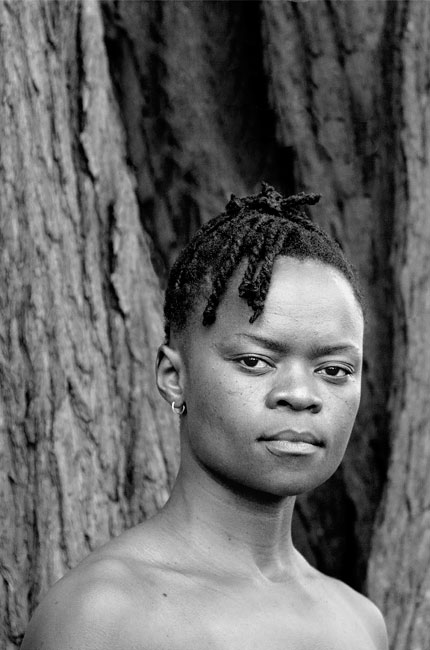
Tumi Nkopane, KwaThema, Springs, Johannesburg, 2010. Featuring in Faces & Phases by Zanele Muholi

Tumi Nkopane, KwaThema, Springs, Johannesburg, 2010.
Featuring in Faces & Phases by Zanele Muholi

Participant, Tumi Nkopane shares that after shooting her faces and phases portrait, she discovered that she’s actually photogenic and hasn’t stopped taking pictures of herself since.

The more serious issue of hate crime was then tackled, speaking about the children being orphaned by the senseless killing of the parents due to homophobic violence.

The doccie then makes a 360 degree turn and explores issues of intimacy.
As “an intimate being”, Muholi produces intimate pictures. She believes It starts with the same sex love, that is disorganizing the mindset of the homophobe, that leads to lesbians being killed.

“Projecting positivity can sometimes lead to that change, projecting brutality can lead to more violence, we should strike a balance in the way we project these realities,” said the photographer.

One of the questions from the audience was: what can international people do to assist?

To which Muholi replied: how can we collaborate?
For us to kill the notion that Africa needs to saved.
The exchange of skills and knowledge is vital”
she concluded.

After the talk, members of the audience shared their thoughts and feelings.

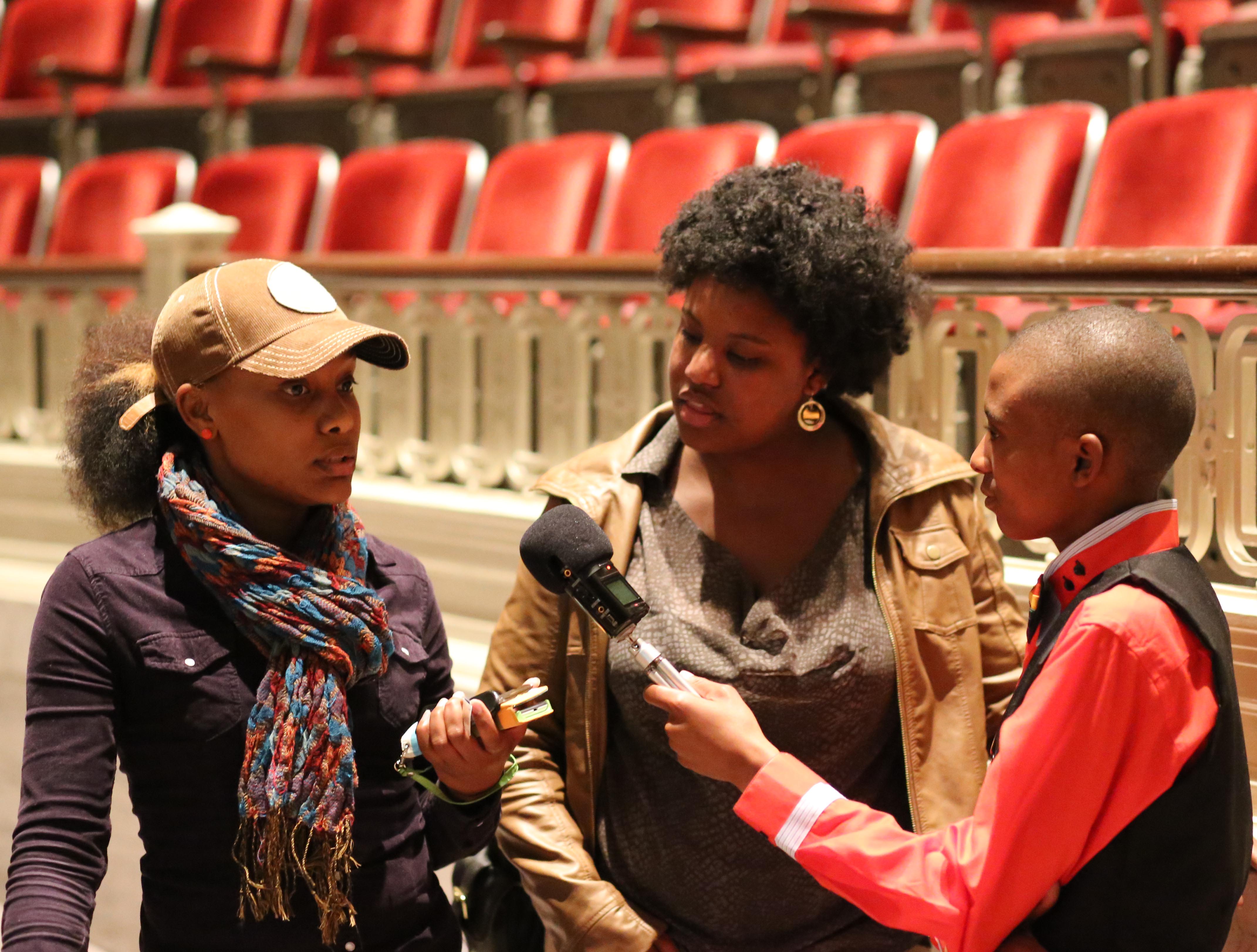
Lerato asking members of the audience questions after the artist talk was over. Photo by Raquel Rodriguez

Lerato asking members of the audience questions after the artist talk was over.
Photo by Raquel Rodriguez

Michelle and Winter said word spread around Facebook and they wanted to attend because, “its hard to find something worth experiencing in Pittsburgh.” The concept of Archiving stood out for them. Watching Muholi’s documentary Difficult love a week before, gave them a fresh perspective, instead of the vulgar images usually shown. “You even forget its two women” said Winter, “the love just stands out, because everyone understands the language of love” she said.

While Raydan Surack loved how Muholi talked about everyone being connected and how we can assist one another globally.

Key and Prin-cess: Key works at the museum as a security and couldn’t meet Muholi even though she spotted her at the opening, because they don’t get the one-on-one with the artists, and also has a passion for photography. “I learned a lot today meeting with members of the gay community” said Key.
Who also revealed that until the talk, she had never been to the library, because she stays in one little area and doesn’t travel too far. Key also confessed that she wasn’t aware of the violence and hate crimes happening in SA.
“Even though we don’t experience the violence there are similarities to the struggles faced. On the surface we are accepted as just ‘flamboyant people’. But we are capable of doing anything that heterosexual people do, and we can produce work good enough for the international” said Key proudly.

Tenisha Sengilterry had a mix of emotions. She said “I’m feeling overwhelming love, I’m feeling great sorrow, mournfulness in a hopeful way, a useful kind of mournfulness, where you absolutely want all of the injustices to be ended as in yesterday, through the power of this work.”


Previous by Lerato

2013 Oct. 7: Art enthusiasts converged

and

2013 October 5: Carnegie opening

Related link

LGBTQ visual activist discusses ‘curative rape’ in South Africa

Posted in 2013 Carnegie Fine Prize, Acceptance speeches, Activists, Allies, Archived memories, Archiving Queer Her/Histories in SA, Art Edutainment, Art Is A Human Right, Art is Queer, Art Solidarity, Beauty, Before You, Bekezela Mguni, Black Queer & Gifted, Collaborations, Creating awareness, Experience, Exposure, Expression, Faces & Phases portraits, Female Photographers, From Johannesburg to Pittsburgh, Gender activist, Gender naming, Hope, Human Equity and Art (Heart), Human rights, Intellectualism, Interpretation, Isililo, Know Your SA Queer History, LA'Tasha Mayes, lgbti, Media works, Our lives in the picture, Power of the Voice, Queer visibility, Speaking for ourselves, Visual Power, women of colour for reproductive justice, Writing is a Right, Zanele Muholi is the winner | Tagged | 1 Comment

2013 Oct. 16: I am a beautiful young dyke, a woman lover


Oyama Mbopa
is a freelance artist who specialises in acting, dancing, singing as well as stunt performance.  She was born in the Eastern Cape in November of 1981 and grew up with her mother and three siblings.
She is a self-proclaimed lover of arts and sports.
Some of the activities that she enjoys partaking in are; rock climbing, hiking, and athletics.
She is also into reading.

Image

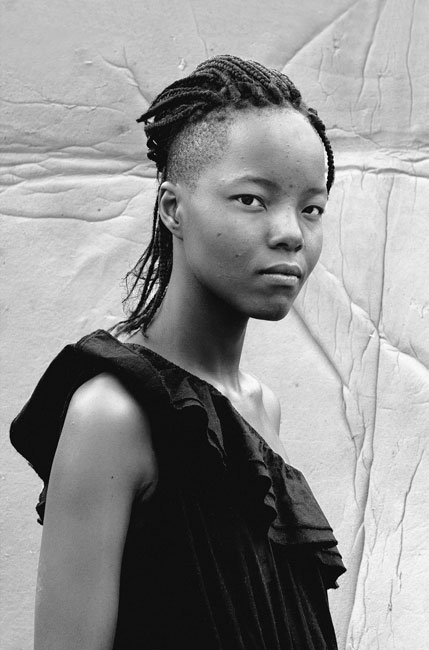
Oyama Mbopa, Athlone, Cape Town, 2010
Featuring in Faces & Phases                                by Zanele Muholi

Oyama, who currently lives alone in Cape Town in the Western Province, attended the Durban University of Technology where she earned a National Diploma in Performing Arts, which was perfectly in line with her love for performing arts.

“I am a beautiful young dyke, a woman lover. In between I have my days of wearing skirts even though I look like a cute little boy” says Oyama.
She is currently not in a relationship but she quips “and if I was it would be with a woman.”
She believes that love is a feeling one shares with only one person. She believes in monogamy and safe sex and says “I, as an individual have no problem to same sex love making, as long as both parties have agreed about it and take the necessary precautions.
Her family has no problem and have no judgement against her nor her sexuality.  In her last relationship her family was supportive but her ex partner’s family had a problem of accepting who she was.

Oyama’s future plans are aimed at tackling ills that her community is grappling with.   The violence towards lesbians is in her eyes undermining lesbian relationships.  “We are not safe in our own communities.  People need to be educated that we are not just a bunch of people who are just playing house – but are serious about life and our sexuality, and the fear of the unknown is what kills our people, they are so closed minded”

She would like to eventually run for public office and become a politician where she can create a platform for other young people who come from disadvantaged backgrounds. “Though we might say we are a democratic country, when it comes to the LGBTi rights which are human rights often taken for granted and we need a serious intervention.
Corrective rape is a very big issue in our country.
Lesbians are murdered day in and day out and still the government and our so called Constitution does nothing for the LGBTi community.
I have future plans revolving around homosexuality, same sex marriage, women and children’s rights and rights of transgender people with disabilities
.”

On why she decided to work with Muholi, she imparted that “I’ve known Zanele since I was 16yrs old.  She’s one of those out spoken activists that had felt that enough was enough and if someone didn’t take a stand and challenge our country’s Constitution and fight for her human rights.
When she told me about the Photo Project I was looking forward to the 2nd edition because I also felt that my picture would help assist other LGBTi people to know that they are not alone in this struggle.”


Related life stories


2013 Oct. 12: I just feel she deserves much better

and

2013 February 28: I am not a Victim but a Victor…

and

2013 April 1: Who are you to tell me who I am?

and

2013 July 15: The virus has become a silent relative

and

2013 Aug. 19: The importance of self acceptance

and

2013 Aug. 22: Am exactly where I’m supposed to be

and

2013 Oct. 2: ‘I am a normal transgender woman’


Posted in 1981 -, Activism, Activists, African Queer Beauty, Art Edutainment, Art Is A Human Right, Art is Queer, Arts, Arts & Sports, Beauty, Before You, Being Scene, Black Lesbian Graduate, Blackness, Body, Collaborations, Connections, Dancing, Dyke, Experience, Exposure, Expression, Female Photographers, Freelance artist, Human rights, Life, Love, Photography, Readings, ReClaim Your Activism, Recognition, Relationships, She, Stunt performance, Together we can, Visual Power, We Are You, Youth voices | Tagged | 6 Comments

2013 Oct. 15: She is my weakness

by Charmain Carrol

When I found out I was pregnant I had two feelings at the same time. I smiled because I was somehow happy while tears were running down my face because I was afraid.

I feared the disappointment. Disappointment in my mother’s face because she always spoke so highly of me.  Feared disappointing my family. Feared growing up. Feared being a mother, because I didn’t know how to be one. I hadn’t been taught how to be one yet.  But most of all I feared disappointing myself.

I was only 18 years old when I was pregnant with her. Today my daughter is 17 years old and we always had an open door policy, we talk about everything I mean everything, so we know what is happening in both of our lives.   I can leave for 3 weeks and I will find everything still in order, house not on fire.
You know the scary things us parents fear when we leave the house under a child’s supervision.
My daughter has not given me any problems with boys, make up, girls, parties, drinking and drugs and I’m so ever grateful for that.

Today I find myself profusely cleaning the house because for once I’ve run out of words.  Words to say to my daughter.  On Monday I got a call from her school stating that she has not been at school for a week. The shock of my life, I was lost for words, words to reply, all I could say I’ will come through on Thursday because I’m on a 3 day editing course.’

Now what was I to say to her without getting angry and giving her a beating, as everyone keeps telling me, because I don’t hide the fact that corporal punishment in my house is still practiced. As old as she is she still gets a hiding.
When did the communication break down start?
When did the open door policy close between us?
I asked her why was she not going to school?
She says she has been, she just did not spend the whole day at school, she left school premises with friends and went to do drama activities in Springs or sat in the park.

So my 2nd question was: did you think I wouldn’t find out or you didn’t care about me finding out?
No answer.
My 3rd question: since you made a choice to bunk school what are your plans because you are going to be expelled?
I don’t have any plans.
My response: Well since you made all these choices without consulting me, this is how it is going to go. You are in Grade 11 so this means you only have a Grade 10, people with diplomas and degrees are sitting at home jobless.

This is what you need to do go find a job. I won’t be supporting you no more.
We need to share the rent, food and electricity for the next 4 months.  After that period you will be 18 and you can leave my house.  If wena (you) have decided to be an adult then you can be one.
I saw tears rolling down her face. I then went straight to bed.

I cried for the whole night. I cried because I had to be cold as ice when I said all of that.
She is my life.  She is the reason I keep going.
Got up in the morning she woke me up and said mah you can go bath now I’m done.  On our way to school I ask her why am I going to school?
What do you want me to say?
Her response: Please ask the principal to give me a chance, I can’t bear to see the disappointment in your face and please don’t give up on me mah.

I wish there was a training course or a manual to this parenting life. I wish I had someone to pass this responsibility too. But I can’t.  That’s what being a single parent means.

Everything you do is done by you, and you alone.

Previous by Charmain

2013 March 8: Affirmation – I Am A Lesbian

and

2013 Feb. 8: “Let your voices be heard”

Posted in Anger, Another Approach Is Possible, Archived memories, Before You, Betrayal, Commitment, Creating awareness, Difficult Love, Education, Homosexuality, Hope, Human rights, Hurt, Knowledge, Life, Love, Maternal love, Power of the Voice, Public spaces, Relationships, School, Silence, South Africa, Speaking for ourselves, We Are You, We Care, Women's power | Tagged | 13 Comments

by Zandile Makhubu , Rene Mathibe
Photos by Xana Nyilenda

The atmosphere was foreign, people conversing, little discussions about the world of arts and how it all affects us all in our different worlds and how we relate to it.
Inkanyiso was at the much awaited for exhibition of Jerry Obakeng Gaegane a recipient of the 2012 Edward Mentorship which is supported by the AngloGold Ashanti.
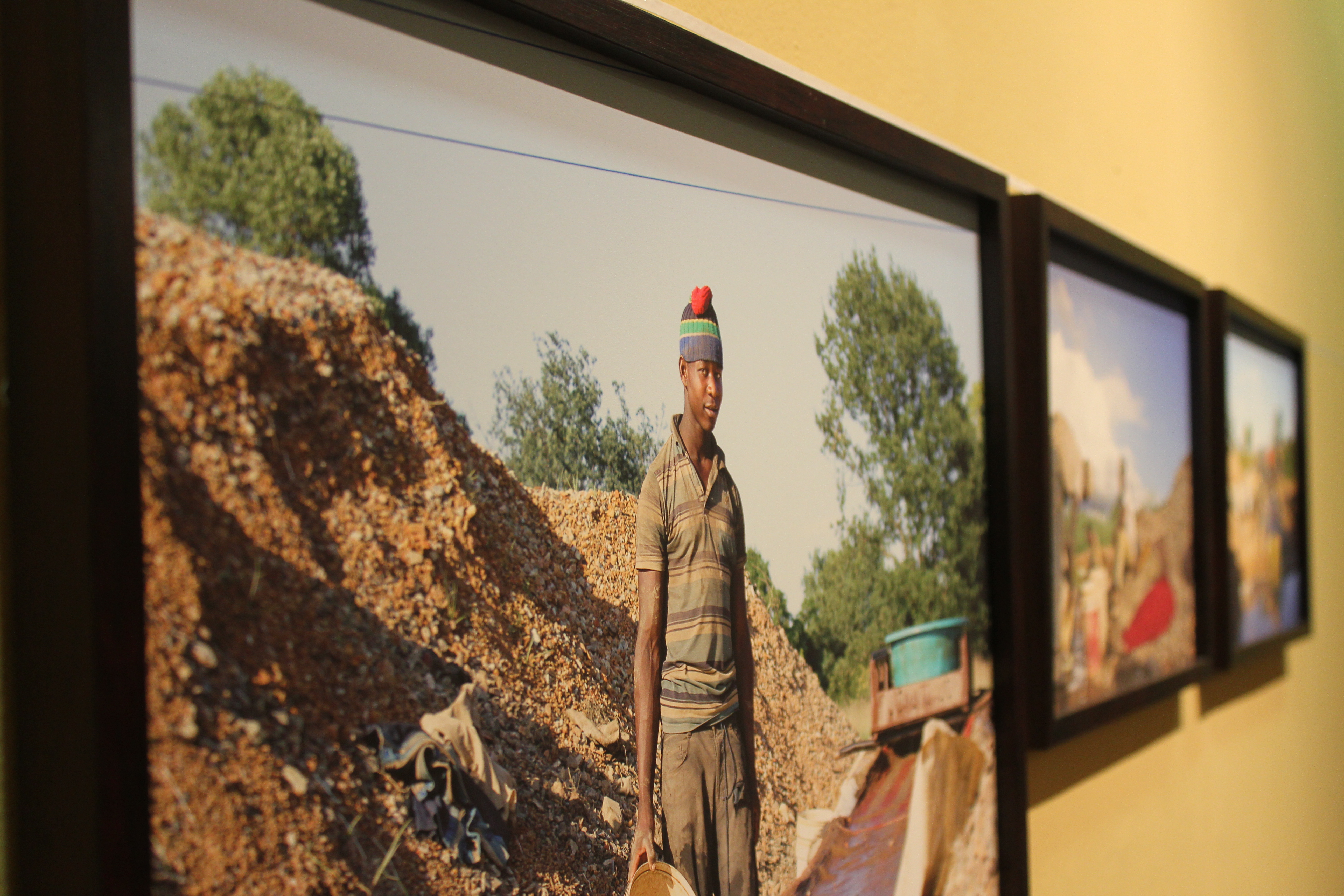
Gaegane digs deeper into the lives of miners and their daily struggle to survive; ironically these are the very same people who extract wealth. His work is a documentation of miners and it explores the harsh working environment they are accustomed to. He plays with the idea of the sunrise or the horizon being a division between underground and surface mining.

miners1_2864

The mistreatment of mineworkers is still a raw issue in our country.  Gaegane’s work distinctly shows the behind the scenes of mineworkers and their poverty stricken lives.
A photograph that captured my eye was of young informal surface miners at home, taken in Matholeville, Roodepoort. The intergeneration of these mine workers puts the question in mind regarding child labour.

The regulations put in place our constitution to protect the children seems to be overlooked.  There’s much to be seen and so much to be heard but the photographs show the will to speak out and be heard but helplessness has been the norm emotion. With the little income they receive, it’s always hard to stretch the income in order to sustain themselves and their families back home. Some of the miners live far from home; some of them have crossed borders to look for work in the mining industry. Magomosha, a Sesotho term used to describe informal migrant mine workers from Lesotho, have to share a single room in the West Rand.

Survival of the fittest is the probably a fit term to use, as I see the drenched, emotionally drained faces of human beings who are trying to make a living and lead honest lives, the order of the day is scrambling for that little change to buy bread and keep their roofs tight from the rain.
“They say that to see the light of day is very important for them as it gives them the spirit of life” Gaegane explained.

Jerry speaking at the opening of his exhibition

Jerry speaking at the opening of his exhibition


The exhibition is at the Market Photo Workshop, Newtown Johannesburg. It will run until the 20th of November 2013.


2013 Feb. 7: Art Is Where the HeART is

and

2013 Sept. 30: Intimate kisses at Soweto Pride 2013

and

2013 Oct. 4: Cramps were killing me

and

2013 Feb. 14: Hello, my name is Zandile, and I am in love with a woman

Posted on by inkanyiso2009 | Leave a comment

2013 Oct. 7: Art enthusiasts converged

by Lerato Dumse

“I was in a very abusive relationship and in love with a certain person. When mama came to Joburg after receiving a threatening call, my ex lover told her that she was madly in love with me. My mama said to her, ‘when you love someone you don’t need to be violent or hurt the one you love. So love each other’.
When mama returned home in Durban she informed the rest of the family and asked that my relationship be respected.”

This was Zanele Muholi’s response to a question about whether her family was accepting of her sexuality. It was asked during the Q&A session of her talk with the Photography Associates at the Art Institute of Chicago (AIC), which is the second largest art museum in the United States. They are an intimate group of about forty or so serious collectors and photography enthusiasts.


AIC_8070

“Marking, Mapping and Preserve-ing an often invisible community. With her camera, she’s created and continues to create an archive of positive images of queer black culture in Africa.” is how Liz Siegel, associate curator of photography introduced Muholi to the audience.

The art activist started the talk by reminiscing about the 2006 Chicago Gay Games, US. Muholi attended with the Chosen FEW lesbian soccer team of which some of the players feature in her photography. “I should confess that, the work is not about me, but the people featuring in my work. I happen to be the driver of the wagon that has so many people. I don’t call them subjects but participants, just like you are participating in this discussion right now.

Muholi spoke about racism and Apartheid South Africa, how it robbed many people of their loved ones and distorted part of South African history.
“Today there is a different fight, whereby parents are losing their children simply because of their gender expression or sexual orientation” said the visual activist/ photographer.

Some of the people in the photographs have children. Some are professionals. Some are survivors of hate crimes. Some are close personal friends of Muholi, while others have since passed away. The work is done to ensure that the will be a history that speaks to everyone, and if we speak of a South African history then everyone should form part and parcel of that history.

Forty eight (48) photographs were selected for the Carnegie Museum group exhibition out of 220 Faces and Phases series and Muholi is aiming for 500 as the target number for the lifetime project.

The group was informed that the award winning activist/ artist doesn’t work from a studio ‘nor use of artificial light.’

Dawoud Bey & Zanele Muholi_8033

Muholi with Dawoud Bey, African American best photographer who attended the artist talk.
Photo by Lerato Dumse (7th Oct. 2013), Chicago

She showed portraits of herself saying she doesn’t mind being photographed, because she does the same to others and also wants to be remembered as a member of the SA queer community in history.

Two documentaries, one 2 minutes long, commissioned by Puma and another, an
11 minutes long Human Rights Watch (HRW) documentary were presented to the members of the Photo Associates.  They were shot in three South African provinces: Johannesburg, Cape Town and Limpopo.

Another question asked was: what is being done to combat hate crimes in SA?

To which Muholi answered,

“Various campaigns have been established, but the large diverse population leads to us pulling in different directions. Proper education of the Constitution in all communities is necessary and needed.

Andria Sandler describes herself as an art junkie who buys a lot of photography.

She’s seen Muholi’s work at different shows, even traveled to Cape Town and loves black and white photography. “I love work that’s political and has an edge and I bought the book in San Francisco” concluded Andria.

Barbara Rueben from Chicago has been collecting art for over 30 years. She was introduced to Muholi’s work at Stevenson gallery in Cape Town and has been following it ever since. “The talk was great, giving a much stronger insight, and her contribution to society is incredible. What she is doing in Africa is very exciting, giving a voice to an otherwise invisible part of society” continued Barbara who said the visuals are powerful.


Previous by Lerato


2013 October 5: Carnegie opening


and


2013 Oct. 10: The Artivist Talk visuals


Posted in Africa, Another Approach Is Possible, Archiving Queer Her/Histories in SA, Art Activism in South Africa, Art Edutainment, Art Is A Human Right, Art is Queer, Before You, Being Scene, Chosen FEW, Experience, Exposure, Expression, Faces & Phases portraits, From Johannesburg to Chicago, History, Homosexuality, Interpretation, Know Your SA Queer History, Lerato Dumse, Networking, Organizations, Our lives in the picture, Penetrating mainstream spaces, Photography, Politics of representation, Power of the Arts, Power of the Voice, Presentations, Professional black lesbians in South Africa, South African Black Female Photographers, Speaking for ourselves, Textualizing Our Own Lives, Visual history is a Right not a luxury, Visual Power, Visualizing public spaces, We Are You, We Care | Tagged | 14 Comments

2013 Oct. 13: Frustrations of a transgender man


by Njabulo Masuku

Accessing treatment for a transgender person in South Africa is frustrating. Although we are almost 2 decades into the democracy in South Africa not all of us are enjoying the benefits of the Bill of Rights.  The standard right of transgender persons to receive primary health care at their local clinic or hospital is nonexistent in 7 of 9 provinces of the country. The only provinces that offer services are in Gauteng and Cape Town.
I live in Mpumalanga, about 150 km away from Johannesburg.
Travelling to and fro Johannesburg costs about R200- depending on where in Joburg you are going.

If one is blessed enough to be employed in this country where unemployment rates are escalating abnormally and currently teetering at 30%, travelling to and fro Joburg is doable.  To get started with your transition is possible, if a therapist recommends 10 sessions worth about R700- per session.
If the therapist agrees to see you 3 times a month then one must be prepared to part with R2 700 – a month which is a pricey sum for an unemployed or under paid transgender person living in Mpumalanga.

Seeing that I could not afford the fees, I explored some options in Emalahleni where I am from.  I was so devastated to learn that a third of doctors in this industrial capital of Mpumalanga aren’t even aware what Gender Identity Disorder (GID) is.
A local doctor, Dr ??? referred me to a plastic surgeon who in turn referred me to a gynecologist.  It was a sad realization for me to see that our doctors were not equipped with handling people like me.  I even googled to see if there was an Endocrinologist in Emalahleni, but it was in vain.

I decided to seek help from one of the most prominent transgender organization in the country by petitioning them for help.  I got no response but persisted through on Facebook.  I contacted a second organization as well, seeking funding for my medical assistance.  One organization said they did not have an allocation in their budget to assist transgender persons in my province and the other advised me to come over to their offices but I did not have the requisite bus fare.

It is such a bleak reality for women and men like me, who live in remote areas like myself.  We are sentenced to living a lie and those that are supposed to help seem to not be able to do so.
Two months ago I contacted an organization that deals with lesbian, bisexual and transgender persons to see if I could access their free therapy program.
I wanted to at least be able to get a referral letter in order to get started on hormone therapy.
They promised to get me an appointment with a therapist but I am still waiting.
I joined an online support group and interacted with someone who was going to advocate on my behalf, but they met the same silence.


Related articles


2013 Aug. 9: Transgender youth suicide in Johannesburg

and

2013 Oct. 4: I sensed something was wrong


Posted in Activism, Creating awareness, Evidence, Experience, Expression, From Mpumalanga to Johannesburg, Gender activist, Gender naming, Hope, Human body, Human rights, Hurt, Institution, Knowledge, Life, Our lives in the picture, Penetrating mainstream spaces, Politics of existence, Politics of geography, Power of the Voice, ReClaim Your Activism, Recognition, Relationships, Seeking help, South Africa, Together we can, Transgender visibility, Transgender Voices, Transgenderism in Africa, We Care, We Still Can with/out Resources | Tagged | 1 Comment

2013 Oct. 11: Meet our own lesbian actors

A video production by Inkanyiso media.

Synopsis to be posted later.


NB: ***We apologize for Kopano’s wrongly spelt surname.


Previous videos

2013 Sept. 29: Soweto Pride 2013

and

2011 May – GDX – SIPD Exchange Programme

and

2011 Nov.: Trans Health & Advocacy conference hosted by GenderDynamix


Posted in Acting, Activism, African Queer Beauty, Alternative family, Another Approach Is Possible, Archived memories, Archiving Queer Her/Histories in SA, Art Activism in South Africa, Art Is A Human Right, As we are, Black Queer & Gifted, Power of the Arts, Queer Edutainment, Queer visibility, Zulu is a South African language | Tagged | 7 Comments

2013 Oct. 12: I just feel she deserves much better


Dee’s story

An avid soccer player, Debora Dlamini prefers to be called Dee, a name she got while actively playing soccer.
She describes herself as “sweet, understanding, calm and focused” but is also an open book and a straight shooter – what you see, is what you get.
Born in Gauteng in 1989, she was raised by her mother and grandmother and lived with her siblings and cousins.   She feels so indebted to their raising her that she muses that if she makes it big.  She hope to change her mother’s life for the best and look out for her family as a whole. “I just feel she deserves much better, I would take her on the vacation for few weeks and rebuild her house.”

In 2008, she matriculated at Hulwazi Secondary School but failed to get a passing grade.  She re-wrote it in 2009 and was successful.
In August 2012, she underwent training to work in a call centre. In December 2012  was offered employment at Discovery Health in Centurion.

Image

Debora Dlamini, KwaThema Community Hall, Springs, Johannesburg (2011).
Featuring in Faces & Phases series by Zanele Muholi.

She knew then that her life was changing for the better.  After passing her Matric she could not go beyond grade 12 because of the money problems at home. While in her final year at school, she had been offered a bursary, but could not meet the requirements because of her failing grades.  She now understands the missed opportunity but that will not stop her reaching higher.  She would like to own her own business and would like to pursue Business Management as well as sitting for a Mathematics exams, which she did not do to well in before.  She insists on doing it again and better this time because her current grade is “very poor for an upcoming business woman.”

Since landing her job, she moved to stay in Pretoria.  Previously lived in Daveyton and was heavily involved in the community activities.  She was the co-ordinator of UTHINGO – the rainbow. She was also the chairperson at the Treatment Action Campaign (TAC) campaign for gays and lesbians in Etwatwa, Mina Nawe and Daveyton.  She was educating the community around HIV and AIDS.  She was also involved with LoveLife Youth program, which works at trying to end the stigma faced by gay and lesbian youth.
She reminisces about involvement in the community and wondered whether they missed her there.  She intends to get back into working with community organisations that helps empower gays and lesbians.  When she is not working hard, she enjoys coaching soccer, listening to music and organizing events.

Even after doing all this work and coming face to face with many issues faced by the LGBTQ community, she was not prepared for the realities of life as a lesbian in Olievenhoutbosch.  She describes the area as backwards, and describes the male population as being very closed minded and homophobic.   Dee lives with her girlfriend, and sees herself as “a woman who loves other women and whose identity and sexuality is being a masculine butch with a feminine side. I am still a woman who is responsible and liable for my actions. The best thing is I know what I want. I am not confused.”

She has been dating Ntokozo Mkhabela since October 2011. Her family is in Mpumalanga and although they have been dating and living with each other for so long, they were not aware until February 2013, when she decided to come out and tell them that she was a lesbian and that she had a girlfriend.  Her family was not even aware of the term lesbian.  It wasn’t easy for them to believe it or even comprehend. Her brother in Tembisa is the one who explained the technicalities.  Dee’s family were resistant to her orientation at first but with time, they understood that she was not changing for anyone – whether they berated her or not.

Dee feels that love is precious and grows where it wants, regardless of gender.
She, however, knows that not all people share her ideology.   She is saddened by the fact that in this day and age, when men see her and her girlfriend, they curse them out, call them names and blatantly tell them that they will rape and/or kill them.  As a result they do not hold hands, kiss or cuddle in public.

Her feelings of being unsafe are even more real in the place where she currently lives.  She describes attitudes of some people there as still being steeped in culture and the men do not believer in same sex marriage as they say women were made for men and men were made for women.  “I really think they need more knowledge about lesbians and gays. They need to know about human rights and that everyone has a right to be what he or she wants.”  She also believes the other problem is that of bisexual women who have sex with lesbians and these men. “I don’t say there is something wrong with bisexuals but I say they must be out and proud. The place where I live people needs knowledge.”

Dee knows that where she is there is a platform to make a change in the world.
She recalls a time when a man she thought was her friend tried to rape her at gunpoint because of her sexual orientation.  She could not call the police, even though she had managed to get a window of opportunity, because she knew that the police were in his pockets.  She would be the one to lose.  There is no justice. She would also like to tackle issues plaguing the youth, e.g. teenage pregnancy, abortion, crime, alcohol and drug abuse, unemployment, respecting the environment, their bodies and embracing and understanding the importance of going to school and getting an education.

She says of working with Muholi, “When I got the opportunity to work on a photo shoot with Zanele Muholi, I was very happy because I was about to experience and be part of something unique.  I was already out of the closet and I was free.  It was my first time doing a photo shoot for Zanele Muholi.
I knew that whatever we would be making would change a lot of people’s lives. Even thou I was scared of doing the photo shoot, I found myself enjoying the experience and having fun with Zanele and the crew.
I want to take this time to thank Zanele Muholi for the chance she has given me to tell my story to the world about challenges that we face as lesbians and gays.
I want to thank her for the effort she’s putting on her good work.”


Related life stories

2013 February 28: I am not a Victim but a Victor…


and

2013 April 1: Who are you to tell me who I am?

and

2013 July 15: The virus has become a silent relative

and

2013 Aug. 19: The importance of self acceptance

and

2013 Aug. 22: Am exactly where I’m supposed to be

and

2013 Oct. 2: ‘I am a normal transgender woman’


Posted in 1989 -, Acceptance, Activism, Another Approach Is Possible, Archived memories, As we are, Blackness, Community, Community Mobilizing, Creating awareness, Debora Dlamini, Empowerment, Expression, Faces & Phases portraits, Family, Former soccer player, Gauteng, Homosexuality, Lack of Resources, Life, Love, Organizations, Our lives in the picture, Power of the Voice, Profile, Relationships, Self acceptance, Survivor, We Are You, We Care, We Still Can with/out Resources | Tagged | 10 Comments

2013 Oct. 10: first woman


by bekezela mguni


Call me Eve

I’ll split a pomegranate with you

Share worlds unknown

Only selfish gods would hide

Insecure about their place in the sky

I really want to know you.

Beyond dusk,

Before dawn

Close and quiet,

Loud if you like

I’ll have you oceans wide and bottoms of seas deep

As vast as you are

an endless horizon,

a new constellation,

a thousand time reincarnation,

a Song of Solomon chanted by his most devoted lover

I will write you new gospels

Salvation living on the tips of my fingers

This body is holy

My name a hymn,

Call me

My walk a prayer,

Watch me

Liberation in my embrace,

Come

I will hold you

I can


© bekezela
2013


bekezela mguni is radical librarian, activist, poet, doula, candle maker and cultural worker.
she believes that the collective sharing of knowledge, beauty and inspiration is a part of life’s purpose and brings that intentional spirit to her work.

born in San Fernando, Trinidad, bekezela is currently living in Pittsburgh, Pennsylvania and has 10 years of community organizing experience, in which she has worked with LGBTQ communities, youth, women and people of color. she has been organizing with young women of color since her time at the University of Pittsburgh where she co-founded Sisters Beyond the Surface in 2003.

shortly thereafter, she co-founded New Voices Pittsburgh: Women of Color for Reproductive Justice, the only Human Rights organization in Pittsburgh led by, for and about women of color.
bekezela graduated with a Bachelor’s degree in Africana Studies and a Certificate in Women’s Studies.
currently, she is the Program Director for New Voices Pittsburgh where she manages the SistahSpeak!
Youth Project, Women of Color HERStory HERStory Month and the LGBTQ Women of Color Reproductive Justice Series.
bekezela also serves as a proud member of the Ujamaa Collective – a business cooperative for women of African descent working to build a local and sustainable economy in the Hill District of Pittsburgh.
bekezela collaborates with various artists, educators and activists in Pittsburgh in educational, artistic and social justice endeavors.

she is a 2012 Urban Justice Center Human Rights Institute Fellow and  2011 Cathy Raphael Champion of Change recipient from the Three Rivers Community Foundation.
most recently she has completed her Masters in Library and Information Science and was blessed to participate in the first Librarians and Archivists to Palestine delegation in June of 2013.

Posted in Archived memories, Art Is A Human Right, Art is Queer, cultural worker, Feminist Art, Friendships, Interpretation, Life, Our lives in the picture, Pittsburgh, Power of the Voice, Reflection | Tagged | Leave a comment