A Conversation with Wendy Khumalo on Rugby Coaching and Photography

by Wakhe Sebenza

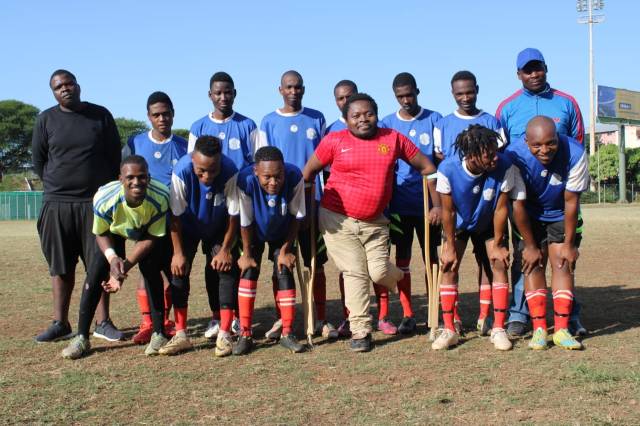
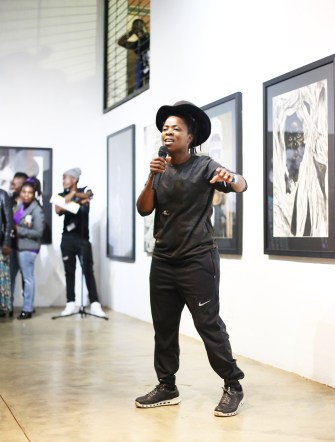
Like the rainbow flag, we are bold, lively and colourful, it’s Pride month – a global initiative celebrating diversity, inclusion and acceptance to raise awareness of LGBT+ rights. We are speaking to some of the Extraordinaires within the LGBTIA+ community. We spoke to Wendy Khumalo, she is a former Springbok Women’s rugby player, currently a rugby coach and also a Photographer, let’s get to know her and the work that she does.

It is true when they say it takes a village to raise a child, with the work that Wendy does, coaching the younger generation rugby, the love and support she gives the children. She is also a photographer, one of the careers that maybe overlooked as a career, Wendy’s message to a student who might be in matric and they are about to make that choice? They want to be photographers, surrounded by people who don’t understand their career choices, could be the classmates, the class teacher or the family and now they have doubts because they are surrounded by a lot of negativity towards their career choice;

I believe that whatever you want, if you want it bad enough, you will do it, you will move mountains to achieve what you want to achieve… Sometimes you do need to make mistakes on your own terms, because when you do make the make mistakes yourself no other person  telling you that you should do A,B,C and D, when you make the mistake yourself you learn from that mistake and you grow from it.

For more wisdom from Wendy, Click on the link Below:

Posted in Uncategorized | Leave a comment

2019 July 14: The man behind Somnyama the song- DJ Kabila

by Wakhe Sebenza

His love for the deejay box dates back to the late 1990s. He has an undisputed gift of knowing how to keep a capacious, jam-packed dance floor rocking the entire night. His love for music remains untainted even after a car accident that left him wheelchair bound in September 1999. It was exactly two months after his accident that he started exploring his talent with beats, Real name Siyanda Makanya he goes by the name DJ Kabila. His name appears on some of the biggest projects, like Blackcoffee Ibiza 17 Appreciation mix, we see it on house afrika sessions 8, We spoke to him about his journey to music and his new hit single Somnyama with Wendy Soni on the Vocals.

He also speaks about being part of Somnyama Ngonyama interpreted by 25 KwaZulu-Natal visual artists, Ikhono LaseNatali Exhibition, of cause in his own artistry, He has a new song Titled Somnyama. Enjoy the conversation on the link below

Posted in Uncategorized | Leave a comment

2019 June 14: Wendy Soni, Her vocal highness behind Somyama

by Wakhe Sebenza

The amazing vocals behind Somnyama by DJ Kabila, her name is Wendy Soni. She is a Musician and a business woman. She is featured on some hits such as Intokazi with DJ Cndo to name one, but today we are talking Somnyama.

Her love for music began back at school and after matric she decided that’s exactly what she was going to pursue. Story of a black child, there was not enough money to further her studies but that didn’t stop her from chasing her dream. Trained by the streets, went from one theatre to another.. It’s all on the audio below, Enjoy.


Posted in Uncategorized | Leave a comment

2019 June 13: Using soccer and Pool to change lives

by Nonkululeko Dube

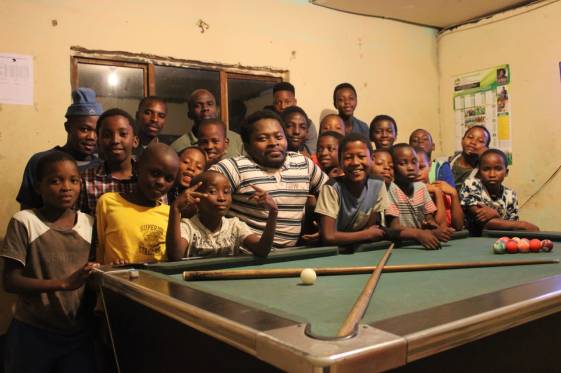
“I realised these kids are not bad they just need guidance and a father figure. I had to introduce sports to them” says Siyabonga Ngcaweni known as “Coach” in Pantus Hill community, an informal settlement located in Ethekwini Metropolitan Municipality, KwaZulu-Natal, South Africa.

35-year-old Ngcaweni is from Umzimkhulu but practically grew up in Pantus Hill. He was raised by both parents, until his father was shot dead in 2002. Coach was born differently abled and attended Open Air, a boarding school that provides education to children with special educational needs. This is where his love for sports started. He played pool and table tennis.

PHOTO-2019-06-11-12-33-21

Ngcaweni studied computer studies at Durban University of Technology in 2004 and also studied Digitising and video editing at the National Electronic Media Institute of South Africa known as NEMISA in 2006. And is currently working as an information officer for the Department of Health Ethekwini District office. Ngcaweni has worked hard for his name “Coach” as the founder of the Social League for pool tournament in Pantus Hill founded in 2011 and also as the co-founder of four soccer teams in Pantus Hill.

IMG_1108

He says back in the day “Pantus Hill was a rough place for everyone” his study showed that the high crime rate was caused by a high population of working single mothers, lack of good role models and lack of sports in the community. That inspired him to form a pool team, recruiting young people to join the team. That way he was keeping them out of the streets. He says, “I wanted to make that impact of changing the upbringing of the kids in Pantus Hill through Sports”. Coach has opened his home to these kids, even his WIFI router so that they are able to have access to the internet for school related projects. This way he is able to keep an eye on them during weekdays while they are studying.” It is a huge responsibility but I enjoy every moment of it” he said.

PHOTO-2019-06-11-12-33-22

Over the past nine years Coach Siyabonga has mentored and life coached over 374 boys, however he still struggles with some of the parents who lament that he is coaching a “tavern sport.” He says he understands the fact that in black communities you usually find pool in taverns and shebeens. With soccer he says it demands a lot of cash flow especially when transporting the boys and the registration fee for Durban Central SAFA local football association. Coach says he wishes that his pool team makes it to the provincial competition so that they can receive KZN colours then they will qualify for nationals and for his soccer teams to grow.

Nosipho Majola (44) a community leader has been a resident in Pantus Hill for 19 years and says her mind is always at ease when her kids are going to play soccer because its safe for them to be participating in sports other than not knowing where they are. She is one amongst many parents who are concerned about their kids due to high rates of alcohol and drug abuse in their community. Majola sees the impact of having sports in the community and the change Coach Ngcaweni along with his partner Alex Ndovela have been making.

Related Posts:

2019 May 25: Seven Day Durban Report

2019 April 28: Sebenza Durban Experience

2013 August 9: For the love of sport activism

2019 May 27: Umbelebele Grade 12 tour to watch Banyana vs Jamaica

Posted in Arts & Sports, Bringing photography to the community, Community, Community based media, Community education, Community Mobilizing, Community organizing, Community outreach, Community work, KwaZulu Natal, KwaZulu-Natal, Soccer, Soccer coach, Soccer is a human right, soccer player, Sport Activism, Sportsperson, Uncategorized | 1 Comment

2019 June 12: Ikhono Lasenatali: a collaborative step towards the rise of art in Africa.

by Welcome Lishivha

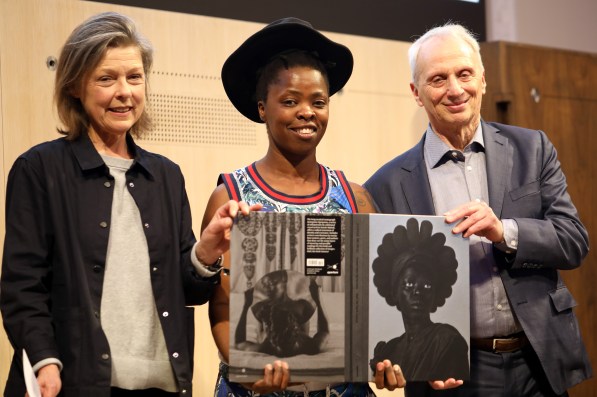
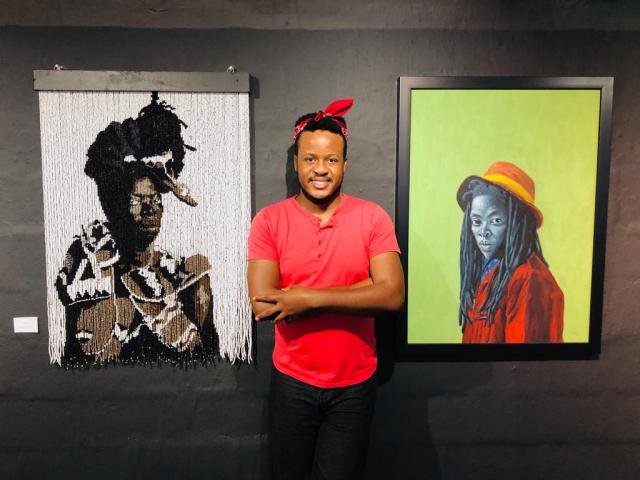
The KwaZulu-Natal Society of Arts (KZNSA) displayed artworks made from various mediums (ranging from charcoal, woodcut carving, beaded string, oil and acrylic on canvas and paper, pastel on paper, and others) interpreting Professor Sir Zanele Muholi’s Somnyama Ngonyama: Hail The Dark Lioness, an ongoing photographic project that recently received the Kraszna-Krausz Foundation best photography book award at an event hosted at the Royal Society of Arts in the UK.

Zanele Muholi receiving the Kraszna-Krausz the 2019 book of the year award photo by Lerato Dumse

Zanele Muholi with 2019 Best Photography Book chair of judges, Liz Jobey (left) and Kraszna-Krausz Foundation Chairman, Sir Brian Pomeroy © Lerato Dumse

In Somnyama Ngonyama, Muholi offers audacious photographs of themselves that are depicted in a vulnerable light yet also foreground their blackness in a manner that’s glaring and powerful, embodying the book title: Hail The Great Lioness. Muholi’s work in this book centres on race, gender, sexuality and representation. The work is a deliberate attempt to transgress dominant ideas of access, exclusion and representation. The work tackles these difficult subject matters with a ferocity that’ll haunt you long after you’ve left the gallery.

The Ikhono LaseNatali exhibition, which officially opened on 17 May 2019, features multiple interpretations of Muholi’s body of work from Somnyama Ngonyama. Ikhono Lasenatali translates into ‘talent in natal’, referring to the 25 talented young artist from KwaZulu-Natal. Muholi further explains that Ikhono is also a word play on iconography and that the ‘natal’ refers to a kind of rebirth of the arts into the kind that centres black people as participants and consumers. “This is about presence and visibility in spaces like museums and galleries where black people were previously sidelined or excluded. We are producing content that will live beyond us,” adds Muholi.

PHOTO-2019-06-13-14-05-03

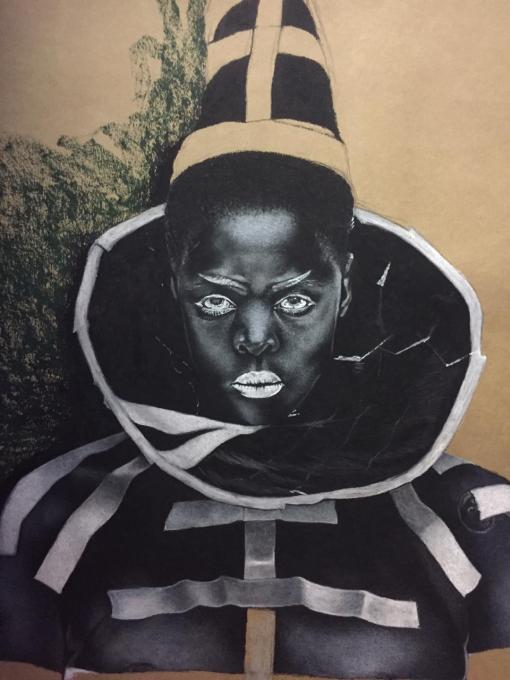
Somnyama Ngonyama interpretation of Vile, Gothenburg (2015) done by Khulekani Mkhize

The exhibition features some of KwaZulu-Natal’s finest artists who have taken very seriously the task of reinterpreting Somnyama Ngonyama in ways that speak to their lived experiences as artists who are established in their own right. Khulekani Mkhize who interpreted Muholi’s Vile, Gothenburg (2015) using charcoal says upon getting the brief, he became so involved in the cathartic act of producing the art piece that it didn’t matter whether or not the piece would be accepted. “The white tapes [that seem to decorate a black regal attire which also seems to act as protective gear] represent my mother’s scars. I started seeing those stripes as my mother wearing her scars. As someone who grew up seeing what my mother went through, this art became a way for me to tell that story,” says Mkhize. He notes that since working on the piece, he has seen the significant influence of this piece and the process of making it in the other work he’s worked on post the piece he produced for the exhibition.

Muholi, who was constantly teased for being dark skinned while growing up in KwaZulu-Natal, says for the longest time they grew up believing they that were ugly. They now recognise the act of declaring oneself as beautiful outside dominant ideas of beauty as being radical and one does not need to go further than their work to see this. Fittingly, they started off their opening remarks at the exhibition opening with the song Zizojika izinto, thula mtanam’ (things will change, cry not my child) and went on to emphasize that this is just the beginning. There will be more projects, including a project for June 16, a project for human rights, a project for tourism and these projects will be followed by books, says Muholi.

Zanele Muholi during Ikhono exhibition speech by Lerato Dumse

Prof. Muholi speaking during the opening of Ikhono LaseNatali © Lerato Dumse

There’s also an upcoming children’s colouring book by Thembi Mthembu that’ll also come out of the exhibition. “What you see here [at KZNSA] is a book that was produced by us and for us and for our children and our children’s children. Our children will play with these books and colour in ways that they know how to. We want to have books with artists and people that we recognise and can say their names,” said Muholi at the opening exhibition on the 25th of May 2019. The exhibition is also a celebration of the 25 years of democracy in post-apartheid South Africa.

“Artists also have a voice and ought to engage in the conversations regarding the state of the country,” notes co-curator Thobeka Bhengu on the commission as being part of celebrating the 25 years of democratic South Africa. The 25 artists were given the chance to interpret Muholi’s work which tackles the political questions of the day around gender, race, beauty and representation. Most of the artist chosen are men whom Muholi had intentions of documenting for the One Hundred Men series. Most of them are also part of the Amasosha Art Movement, a collective of upcoming Durban based artists aimed at creating solidarity among artists.

Professor Sir Zanele Muholi has received much international acclaim for their work dating back to Faces and Phases, which featured a photographic archive of South Africa’s LBTIQ community. Muholi believes in using their renown and visibility to empower others. And so Ikhono LaseNatali comes out of Muholi’s need to give back and help upcoming artists in KwaZulu Natal, where they’re from. This exhibition also forms part of Muholi’s vast work of giving back and helping raise the voices of other artists on the continent.

PHOTO-2019-06-13-14-04-25

Welcome Lishivha posing next to Somnyama Ngonyama interpretations done by (left) Morgan Mahape and Andile Maphumulo (right) © Matthew Jevan

They started a mobile Photo XP workshop dedicated to teaching children as young as primary school learners, in remote areas, some photography skills. In 2009 they also founded Inkanyiso Media, a platform dedicated to archiving and re-writing narratives of the black LGBTIQ community in Africa. For the award-winning artist, collaborating with various artist is key to their practices and Ikhono Lasenataliis testament to this. “Don’t die with ideas, let’s share ideas” insists Muholi at the walkabout of the exhibition on 18 May 2019.

Muholi goes by the pronoun ‘they’ because when you refer to them, you’re not only referring to them as an individual, you are also addressing their late parents and others of their ancestors who have come before them and paved the way for them to exist as they do today. ‘They’ also allows them to transgress the gender binaries and to form an identity outside those binaries. Their strong sense of community and belief in sharing opportunities, is the reason they always travel with one, two or more people (often participants in their photography) whenever they’re invited to talk or exhibit their work around the world. In their rise and stardom, they are really never alone.

Related Posts:

2019 May 24: Somnyama Ngonyama Interpreted to Ikhono LaseNatali

2019 May 20: Ikhono lase Natali exhibition opening.

2019 May 22: 25 years 25 artists Exhibition

2019 Jan.5: Mobile School of Photography Graduation Ceremony  

2019 Jan. 28: Day 1 Review of the Photo XP Maseru


Posted in Akershus Art Centre, Art, Art Activism, Art Activism in South Africa, Art collectors, Art Edutainment, Black Lesbian professionals, Culture of reading and writing, Exhibition, Exhibition opening, Exhibitions, Prof/Sir Zanele Muholi, Professionals, Reviving the culture of reading and writing, Uncategorized, Writing matters, Writing our own | Leave a comment

2019 June 9: Creating and sharing art knowledge in the Eastern Cape.

Text by Aluncedo Cetywayo

Images: by Aluncedo Cetywayo and Charmain Carrol

Wednesday 29 May afternoon in Johannesburg, from Parktown to Park Station with heavy baggage filled with donations for BNM art centre founded by Charmain Carrol based in Ngqwarha, Mount Frere in Eastern Cape.

I am travelling to Mount Frere with Charmain Carrol by bus, we were tired so we spent most of the travelling hours sleeping in the bus until we reached Mount Frere at 5:45am. It is a very small town and it was freezing cold, we had to wait a for a while waiting for Charmain’s colleague to fetch us in town and take us to the village where Charmain’s home is at. The moment we got to the gate at Charmain’s home her dogs Nelly and Timony gave us the warmest welcome jumping on us.

Picture1Picture2

The cold was just too much for me I quickly rushed to bed got warm and rested. At 10 am I was woken up with a hot cup of tea, loving the hospitality here.  I had my tea and got out of bed and took a bath. Charmain then took me for a tour around the village.

That is when we started identifying spaces to take photographs for our collaborated project titled IN HER WOMB a project that I started, writing my thoughts in a form of poetry about the experiences of growing up without my biological mother by my side even though she is still alive.

Picture3

We discussed it and we came to a conclusion of the collaboration, Charmain interprets my writing with photographs. We started with photographing in Johannesburg, and that got us both wanting more locations to photograph in, that is when the travelling to Eastern Cape surfaced.

Sharing the art BNM art centre runs a holiday programme where the children do all forms of art. I have offered to share my theatre\drama knowledge, while we work on the collaboration of IN HER WOMB project. BNM art centre works closely with the pupils of Kuyasa Primary School so I went there to visit and start with the drama lessons with the Grade 7 class. I first had to get to know the pupils so we just had a good hour of introductions which was very fun.  We also discussed random topics that popped in during our conversations, like dating, sexuality and a whole lot of other topics or issues they wanted to talk about. The holiday programme has begun and I will be doing the drama lesson until the end of the holidays, at the end of the holidays we will be showcasing the work we have been doing. I also am planning to have a full script done by the end of this programme.

Picture4

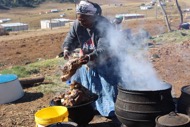
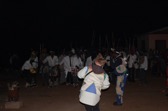
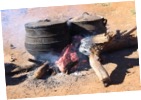
In the Eastern Cape during the June and December holidays is when the tradition of initiating boys over the age of 17 into manhood takes place. This tradition takes boys to the mountain to be taught responsibilities of manhood and they get circumcised. During that process there are celebrations that take place.  Charmain and I got a chance to attend and document the first ceremony called umgubho, which is a celebration of the boys have been given permission by their family to go to the mountain. A bull is slaughtered and is only for men, and another one called iDuna is slaughtered which women are allowed to eat from and there is a lot of traditional beer. Men and women do the traditional dance all night  and drink the traditional beer called Umqombhothi.

Picture7Picture6

The boys going to the mountain are hidden when getting into the kraal where the cows get slaughtered, they are not supposed to be seen by women and those who have never been to the initiation school or mountain. Watching and documenting this ceremony was very interesting and informative. I watched the younger boys doing the dances mimicking the dances the older men. I wondered what is going on in their heads, maybe waiting for their turns to go to the mountain. I ate a lot of meat in the 2 days that we have been documenting this process. I am sure that while here there will be a lot to learn and document.

Previous by Aluncedo:

2019 March 21: Take me to Democracy

2019 May 25: Will my name be there?

2019 March. 24: African women


Posted in "Free from My Happiness", 2012 ReFiguring Women, 2014 Photo XP, 25 Years of Democracy, Acceptance, Activists, Alternative family, Articulation, Being seen, Birth, Black lesbian stories, Black lesbians in remote areas in South Africa, Black Queer Born Frees, Black Queer Born Frees in SA townships, Black Queer Born Frees in South Africa, Uncategorized | Leave a comment

2019 June 4: Muholi donates photographic equipment to Ekurhuleni photographers.

Text by Yaya Mavundla
Photos by Thembela Dick
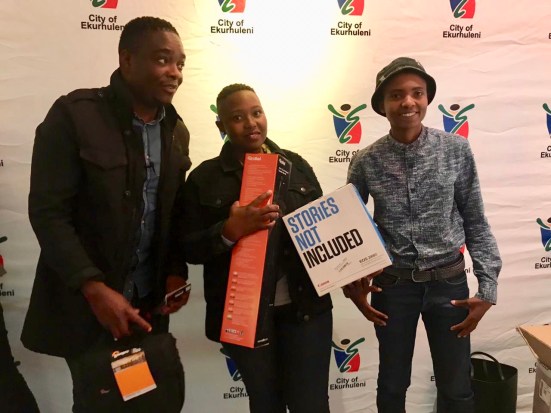
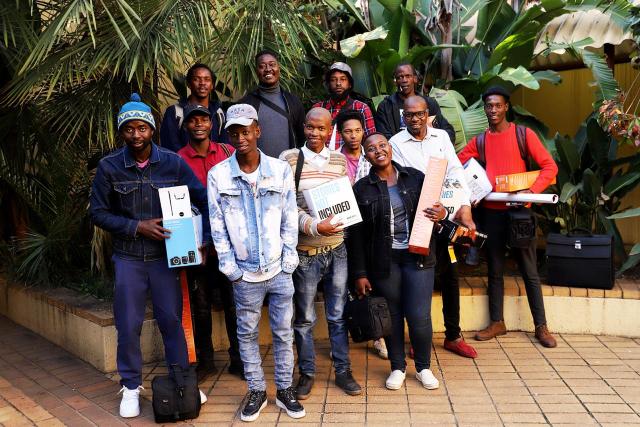
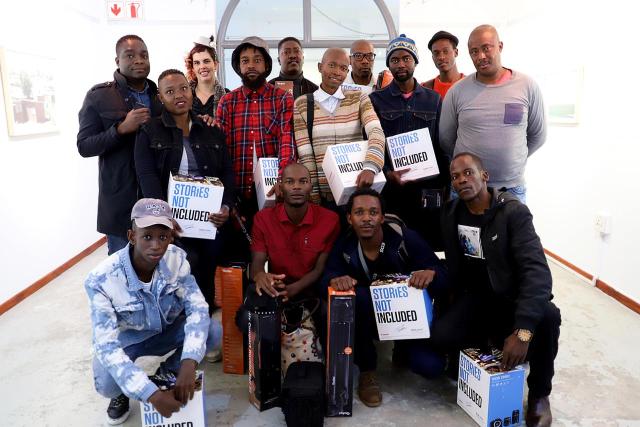
On Tuesday 4 June 2019,  we headed to Springs Art Gallery in Ekurhuleni, Johannesburg, were Professor. Sir Zanele Muholi was scheduled to hand over a donation of 13 DSLR cameras, SD cards, camera bags and compact tripods to the students currently enrolled in the Ekurhuleni Photography Project.
Muholi, an internationally renowned visual artist, activist and photographer born in Umlazi, Durban, is an Honorary Professor at the University of the Arts/ Hochschule für Künste in Bremen.
On arrival, we were informed that Muholi’s flight was delayed and therefore will no longer be present. However the ceremony will continue as planned as the goods were already delivered to the gallery. Muholi was meant to travel from Durban to hand over the equipment to the thirteen (13) photographers, some of them coming from previously disadvantaged backgrounds.
20d0a1bb-d6aa-4c2c-a288-1c20abdbdcc1
With Muholi not able to make it to the event, Lerato Dumse had to step in and hand over the equipment to the thirteen photographers with the assistance from Springs Art Gallery team members. The space was filled with so much excitement during the ceremony, which was evident that all the recipients love photography and this will change their lives for the better.
The13 x photographers are currently showing at the New Breed Exhibition at the Springs Art Gallery. Muholi discovered them during their visit where Muholi was a guest speaker of New Breed Photographic Exhibition at the Springs Art Gallery in April this year and was impressed with what the students had produced with not so good equipment they had.
bf054c16-8bec-4b54-b0c7-0f88524df2c609cfcdb9-5111-4bb6-a237-d0577a0c6315
The exhibition forms part of the City’s commemoration and celebrations
of the life and times of Chris Hani. The exhibition explores, focuses and evokes a unique photographic perspective from students on Chris Hani’s “TRIPLE H” CAMPAIGN; a visual depiction of- and how residents of the City of Ekurhuleni have benefited through, Health, Housing and Hunger relief.
Related posts:
Posted in A new visual history, Black Lesbian professionals, Black Queer Professionals, Camera work, Cameras, Chris Hani, Documentation; Filming; Photography; Community, Exhibition opening, Exhibitions, Give children cameras not candies, Prof/Sir Zanele Muholi, Professional black lesbians in South Africa, Professionals, South African black visual history, South African Visual Activism, South African visual history through the eyes of young women, Uncategorized, Visual activism is a language, Visual Activist and Journalist | Leave a comment

2019 May 29: Stwetla, living in danger but still living

Text by Maureen Majola                                                                                                                       Images by Akhona Hailele

Stwetla is a small section of Alexandra Township which consists of informal settlements only. For many years this area had no electricity nor running water. It was just in 2016 where the community leader Bab Linda Twala built new shacks for some families and installed electricity for the residence of Stwetla.

Over the years there has been families that have been moved by Local Housing to new houses in the area but you will find that most of the people who were given houses will come back and claim their space in Stwetla and build themselves another shack to either rent out or live in themselves.

There are shacks that are built right at the river bank and every time it rains the water levels rise and water floods into their homes, the municipal office has removed most of the people and placed them in a different area but they will still come back and build other shacks in the same unsafe river banks of Jukskei river.

There is little sanitation in the area, there is rubble everywhere, some rubble is thrown into the river and the neighbourhood kids play in the river and risk their lives. There is a cemetery just next to Stwetla and the tombs are not well kept, some are even floating in sewerage. There is little drainage system in Stwetla that leads to the river. The taps are surrounded by dirt and the people still have to go get water from those taps.

The resident’s health is at risk more than anything else as the area is infested with all types of pollution. They use mobile toilets that are collected once or twice a week depending on the responsible company. Some families’ toilets are close to the dumping side and they need to use bricks to step on when they need to use the toilet, some young kids poop on the open spaces in the area. With the lack of drainage systems in the area the residents spill water on the streets, near the taps, next to the toilets and on the dumpsites which makes the area to smell really bad.

On the 11th of April 2019 the African National Congress (ANC) was doing door-to-door campaign in Stwetla and the community members expressed how they felt things have deteriorated and gotten worse since the Democratic Alliance (DA) was in charge of the area. They voiced out that the Mayor stopped a project called Jozi at work which was a clean-up project that helped keep the community clean. The residents of Stwetla felt failed by the Mayor of Johannesburg and they asked the ANC representatives to assist them with their queries and help them get solutions for their problems.

Part of the community’s never ending problems is that there has been a high rise of crime levels and there have been a number of rape cases that have been reported and unreported. Women in the community fear for their lives and their children’s lives. A lot of kids don’t attend school and this is one of the biggest problems in the community. Some of their issues is that there is a lot of foreign nationals who have children who are of age to attend school but they can’t because both mother and child don’t have relevant documents to be in SA. The issue with children needs to be attended urgently as this is a contributing factor to children being violated by men in the community.

We met a number of children playing in their school uniform and when asked why they haven’t changed, they say their parents are not yet back from work and therefor they cannot change since they don’t have the key to the house. This means a lot of young girls and boys stay out till late and are at risk of being violated.

The local, provincial and national government needs to take action before it is too late, they need to see to it that children in the community are enrolled in schools and that their safety is put into consideration. If this means there must be a satellite police station in the area, so be it. The department of Social Development needs to pay a visit to the community as we saw that a lot of parents are unable to protect their children’s safety and wellbeing.

Previous by Maureen:

2019 April 5 “I am Winnie Mandela” concert

2013 June 21: The Princess of Norway pitched just for Muholi

2012 December 27: on 2012 LGBTI Recognition awards

https://inkanyiso.org/2013/08/21/2013-aug-12-sizakele-and-salomes-commemoration-hit-a-slump/https://inkanyiso.org/2013/08/06/2013-aug-6-my-body-as-a-subject-of-hate-crime/

Posted in Against violence on women and children, Alexandra, ANC, Baitiri Lumka Seleka; Charmain Carrol; Kopano Sibeko; Lerato Dumse; Lesego Tlhwale; Maureen Velile Majola; Nation Mokoena; Nqobile ZL, Brutal Killings of children, Issues of sexuality, Let us give a girl child a chance, Maureen Velile Majola, Sexual Offences Bill, Uncategorized | 1 Comment

2019 May 29: Forgiveness

The fragrance that the violet sheds on the heel that has crushed on it.

by Nonkululeko “Sicka” Mthunzi

They say time heals all wounds, but healing comes with forgiving? A wound can heal but does the scar also fade with time without the perpetrator showing remorse? He crushed our little violets and they shed on his heels. Just because he was imprisoned with the last fragrance of our violets, only then does he seek forgiveness. Guess what Rome was not built in one day.

Our societies are fogged with a cloud full of hate, resentment, anger, sadness..etc. Today most of us bare scars caused by the people who were suppose to protect us, love us and nature us but our dignity is dragged through streets that envy our purity. I for one don’t agree with what is being said ” forgive and forget”, yes I will forgive but does it mean I should forget how my mother threw me in a trash pit and never looked back, my father who spent his money with different women while I didn’t have school shoes, or my friend who kissed my girlfriend and told me it was a mistake, not forgetting my educator who scouted my innocence?

I am concerned because forgiveness takes time and it is a process, a journey where sometimes you discover yourself paralysed with anger and fear as a result it is a dangerous tool to you psychologically and emotionally. I am angry and depressed and it kills me every time I walk in these streets, a place that was once my home is a crime scene of my ignorance. Memory is the spear that winds in my dreams with pictures of their innocence painted in scarlet all over these walls. A mother lost her children the day she allowed herself to become a victim of domestic violence. The man that was supposed to be their protector lives behind still bars that remind him every night of the blood shed in his soul. How does she forgive if she was never given room to heal, room to forgive herself, room to ask for forgiveness. Sadly the people that she must ask for forgiveness cannot respond to her request and soon she has to face the monster that once made love to her.

“Forgiveness is the fragrance that the violet sheds on the heel that has crushed on it” , Mark Twain defined the power of forgiveness and his last words when explaining what he meant by this quote is that “Forgiveness is an act of kindness towards yourself and towards all those who will be healed and touched by you as you come fully into your own personal power, free from hate, free from resentment and free from the prison of your past. The world needs you: the healed you, the happy you, the joyful you, the funny you and the you that you were always meant to be. We are looking forward to meeting you.” Forgive to break out of the prisons we locked ourselves in.

Previous by Sicka:

2015 Feb. 19: Trending with Shaz ‘Sicka’ in Oslo

2019 Mar. 20: Struggles of uplifting our townships.

I am making history

2019 Feb. 6: Ukuzalelwa ekhayeni lama Thonga.

2015 Mar.3: A Letter to my Mother


Posted in "Free from My Happiness", "Sheshisa isikhathi siya hamba" by Sicka Shaz Mthunzi, 'Sicka' Sharon Mthunzi, Anger, Gay & Lesbian Memory in Action (GALA), Healing, Healing feeling, Memory, Traditional healing, traditional healing trainees, Uncategorized | Leave a comment